Madrid · Itineraries
Best Day Trips from Madrid: Six by Train and Bus, and What to Skip
Toledo, Segovia, El Escorial, Aranjuez, Ávila and Alcalá de Henares from Madrid by train and bus: times, tickets, opening hours and what to skip.
Checked Research-led

In this guide · 11 sections
The short version
- If you only do one: Toledo. Renfe’s Avant from Madrid-Puerta de Atocha-Almudena Grandes takes 34 minutes. The cathedral costs €12, and a €14 bracelet covers seven more monuments, including the church with El Greco’s The Burial of the Count of Orgaz.
- For the Aqueduct and the Alcázar: Segovia, 27 minutes by Avant from Madrid-Chamartín-Clara Campoamor to Segovia-Guiomar, 6 km out, then city bus 11 or 12 into town.
- On the Tourist Travel Pass: El Escorial, Aranjuez and Alcalá de Henares are on the Cercanías, and a one-day zone T pass, at €15.40, covers the train or the bus there and back.
- The two to skip: Toledo and Segovia on the same day, and El Escorial or Aranjuez on a Monday, when both are closed.
- Check the last train: the last Avant back from Toledo leaves at 21:37, except on 24 and 31 December.
Six day trips from Madrid by train or bus, and two ways of doing them to skip. Each section gives the way there, the journey time, what to see, what it costs and when it opens. Train times are from Renfe’s own published timetable, which runs from 26 November 2026; bus lines are from the Consorcio Regional de Transportes de Madrid (CRTM) and esmadrid; prices and opening hours are from each site’s own pages, checked on 27 November 2026. For Madrid’s stations and the metro, see Getting around Madrid.
How to read this
Renfe’s trains. The Avant to Toledo leaves from Madrid-Puerta de Atocha-Almudena Grandes, and the trains to Segovia-Guiomar from Madrid-Chamartín-Clara Campoamor; Ouigo runs to Segovia too. The Ávila trains given below use Madrid-Príncipe Pío. Renfe publishes its fares and times on renfe.com.
The Cercanías, Renfe’s commuter trains, go to El Escorial, Aranjuez and Alcalá de Henares, and green intercity buses run to all three.
The Tourist Travel Pass for zone T costs €15.40 for one day, €26.20 for two and €35.00 for three. It covers the Cercanías in zones 0 to C2 and the green intercity buses, including services to Toledo, and esmadrid, Madrid’s official tourism site, recommends it for day trips to El Escorial, Aranjuez and Alcalá de Henares. It isn’t valid on the high-speed trains, the Avant to Toledo among them, on Renfe’s regional trains or on the tourist trains.
Mondays. Patrimonio Nacional runs the monastery at El Escorial and the Royal Palace of Aranjuez, and both close every Monday. Ávila’s walls close on Mondays too from 24 October to 26 March, with three exceptions. Plan those three trips for Tuesday to Sunday.
If you’re planning several of these, Where to stay in Madrid has the neighbourhoods.
Toledo
Train: Renfe’s Avant, from Madrid-Puerta de Atocha-Almudena Grandes to Toledo, 34 minutes. In Renfe’s timetable, the 08:15, 09:15 and 10:15 run every day from 26 November 2026 to 24 January 2027. Bus: ALSA’s, from the Plaza Elíptica interchange, 70 minutes, esmadrid says; it’s CRTM’s line VAC023. Fare: the Avant’s is on renfe.com. esmadrid says the zone T pass covers intercity buses to Toledo, and CRTM lists Toledo in zone E2 on this line.
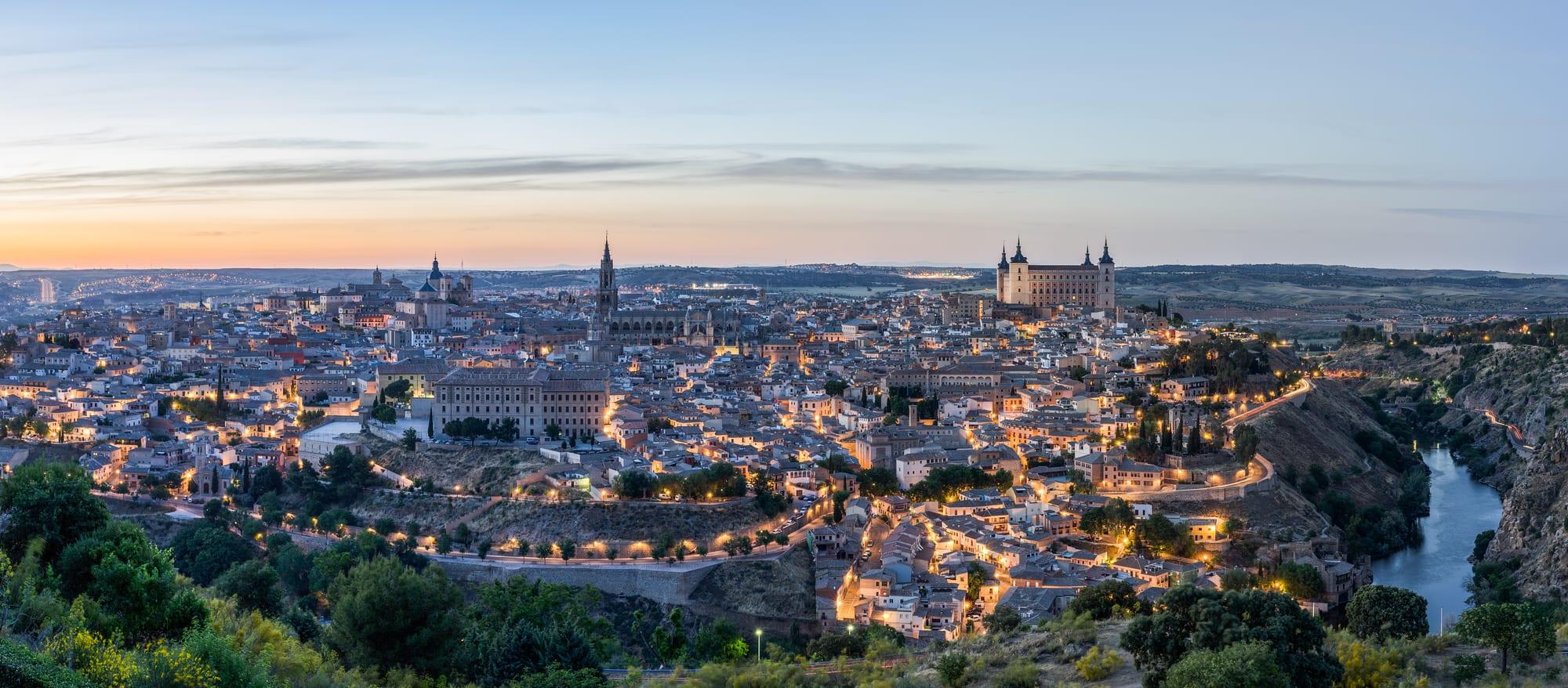
Toledo was named a World Heritage Site by UNESCO in 1986, esmadrid says. For the way up from the station to the old town, see 3 days in Madrid.
Toledo Cathedral, the Catedral Primada, was built in the Gothic style between 1226 and 1493, esmadrid says, and in 2026 it marks 800 years since building began. The visit takes in the Capilla Mayor, the Transparente, the choir, the cloister and the sacristy, which holds the cathedral’s most important works by El Greco. A basic ticket costs €12, or €8 reduced. It opens from 10:00 to 18:30 from Monday to Saturday and from 14:00 to 18:30 on Sundays, and entry closes 30 minutes before. Go in by the Puerta Llana, at Calle Cardenal Cisneros 1. Photography and filming aren’t allowed inside.
The bracelet. Toledo Monumental’s Pulsera Turística costs €14 and covers seven monuments: the Sinagoga de Santa María la Blanca, the Iglesia de El Salvador, the Iglesia de Santo Tomé, the Mezquita del Cristo de la Luz, the Monasterio de San Juan de los Reyes, the Iglesia de los Jesuitas (San Ildefonso) and the Real Colegio de Doncellas Nobles. Each costs €4 on its own, so the bracelet pays from the fourth. Toledo Monumental lists them open from 10:00 to 17:45 every day, and photos without flash are allowed.
Iglesia de Santo Tomé, at Plaza del Conde 4, holds El Greco’s The Burial of the Count of Orgaz, and its own site says that to talk about Santo Tomé is to talk about El Greco and that painting. Entry costs €4, or comes with the bracelet. It opens from 10:00 to 17:45 from 16 October to 28 February, and until 18:45 from 1 March to 15 October.
Monasterio de San Juan de los Reyes, at Calle de los Reyes Católicos 17, was commissioned by the Catholic Monarchs, and Toledo Monumental calls it one of the most valuable examples of the Isabelline Gothic style. Its church, its cloister and its carved decoration are the draw.
Sinagoga de Santa María la Blanca, at Calle de los Reyes Católicos 4, was Toledo’s main synagogue. Behind a plain front, its bright interior is a run of horseshoe arches and white columns.
Mezquita del Cristo de la Luz, at Calle Cristo de la Luz 22, was built as a mosque in the 10th century and became a Christian church after the Reconquista, Toledo Monumental says. esmadrid says it’s the only mosque of its style left of the nearly ten the city once had.
For the view, climb the towers of the Iglesia de los Jesuitas (San Ildefonso), at Plaza Padre Juan de Mariana 1: Toledo Monumental says they give one of the best views of the city. esmadrid also points to the Mirador del Valle, a viewpoint with panoramic views over the river Tajo and the city’s monuments, and to the San Martín Bridge, from the mid-14th century and later rebuilt, which it calls an unbeatable spot for the sunset.
Getting back: the last Avant leaves Toledo at 21:37 and reaches Atocha at 22:15, except on 24 and 31 December.
The verdict: Toledo is the one to do if you only do one. Give the cathedral the morning and four or five of the bracelet’s monuments the afternoon, then take an evening train home.
Segovia
Train: Madrid-Chamartín-Clara Campoamor to Segovia-Guiomar. In Renfe’s timetable, Avants leave Chamartín at 10:15 and 12:05 every day from 26 November 2026 to 24 January 2027, and take 27 minutes. Coming back, the 18:27 Avant from Segovia-Guiomar reaches Chamartín at 18:55, and the last train, the 21:58 Avlo, gets in at 22:25; it doesn’t run on 24 or 31 December. Ouigo runs to Segovia too, Segovia’s council says. Fare: on renfe.com or Ouigo’s site. From the station: Segovia-Guiomar is 6 km from the city centre; city bus 11 runs to the Aqueduct and bus 12 to the centre.
Bus: from Madrid’s Moncloa interchange, in about an hour, the Alcázar’s site says, to Segovia’s bus station, five minutes’ walk from the Aqueduct; Avanza runs it, Segovia’s council says. The slow way, the C-8 Cercanías to Cercedilla and a regional train on from there, takes around two hours, and the Alcázar’s site calls those trains romantic but impractical.
Segovia became a World Heritage Site in 1985, esmadrid says.
The Aqueduct is Roman, from the early 2nd century AD, in the reign of the Emperor Trajan, Segovia’s council says. It was built of large granite blocks set dry, without mortar, to bring water to the city, and the council counts 167 arches.
Segovia Cathedral was begun in 1525, and esmadrid picks out its 16th-century stained glass and its altarpiece designed by Sabatini. A ticket costs €4 and includes the Episcopal Palace. It opens from 09:30 to 18:30 from Monday to Saturday and from 13:30 to 18:30 on Sundays, with no entry in the last half hour. The guided visit to the tower costs €7, every day at 10:30, 12:00, 13:30, 15:00 and 16:30.
The Alcázar, on Plaza de la Reina Victoria Eugenia, is the castle on a promontory between the rivers Eresma and Clamores, and it became a royal residence in the 13th century, the council says. Its Tower of Juan II is 80 metres high, with 152 steps on a spiral stair, and visits to it are limited to 25 minutes; the palace and museum take 40 to 45 minutes. It opens every day, from 10:00 to 18:00 from 1 November to 31 March, with the last tickets and entry 30 minutes before closing. Buy online at entradas.alcazardesegovia.com (another site): tickets that include the tower often sell out, especially at weekends, on long weekends and on holidays.
To eat: esmadrid says no visit is complete without Segovia’s speciality, roast suckling pig, and points to Mesón de Cándido, next to the Aqueduct.
The verdict: Segovia is for the Aqueduct and the climb up the Alcázar’s tower. Take the train for speed, or the bus to arrive five minutes from the Aqueduct.
El Escorial
Train: Cercanías line C-8, 60 minutes from Atocha or 45 from Chamartín, esmadrid says; CRTM’s C-8a runs from Atocha through El Escorial to Santa María de la Alameda. Bus: lines 661 and 664 from the Moncloa interchange to San Lorenzo de El Escorial, the town of the monastery; CRTM’s timetable gives the 661, which IRUBUS (Grupo Alsa) runs, an estimated 55 minutes. Fare: the zone T pass covers both. For the walk from the station, see Getting around Madrid.
The Philip II Train, a heritage train of 1940s carriages hauled by a 1960s engine, runs from Madrid to San Lorenzo de El Escorial in season: in 2026, from 21 March to 12 December, esmadrid says.
Royal Monastery of San Lorenzo de El Escorial. Philip II ordered it, the first stone was laid on 23 April 1563, and it has been a UNESCO World Heritage Site since 1984, esmadrid says. The basilica, under a dome inspired by St Peter’s in the Vatican, has 43 altars and chapels. Under its royal chapel, the Royal Vaults hold 26 black marble tombs of the Habsburg and Bourbon kings, and of the queens who were mothers of kings, and the library has a copy of Alfonso X’s Cantigas de Santa María.
A ticket costs €14, or €7 reduced. From October to March the monastery opens from Tuesday to Sunday, 10:00 to 18:00 (until 19:00 from April to September), and the ticket office and entry close an hour and a quarter before closing: 16:45 in winter. It’s closed on Mondays. Patrimonio Nacional says to buy a ticket in advance, online or at the ticket office of the Visitor Reception Centre, at Avenida de Don Juan de Borbón y Battenberg 4, opposite the north façade. Individual visitors go in by the west façade, through the Patio de Reyes. The basilica needs no ticket, but closes during services. Until 31 December 2026, the Painting and Architecture Museums are free. Guided tours in English run from Tuesday to Sunday at 10:45 and take about two hours; a standard guided ticket costs €22.
The verdict: El Escorial is one building, and a big one. Give it a morning, and take the bus, which runs to San Lorenzo itself.
Aranjuez
Train: Cercanías C-3 from Atocha, 40 minutes, esmadrid says; the line runs Aranjuez-Atocha-Sol-Chamartín. Bus: line 423 from Estación Sur (Méndez Álvaro), 40 minutes; Patrimonio Nacional names AISA and SAMAR as the companies. Fare: the zone T pass covers both.
Its gardens made Aranjuez a World Heritage Site in December 2001, esmadrid says, and for centuries the kings and queens of Spain spent the spring months in its palace.
Royal Palace of Aranjuez, on Plaza de Parejas: €9, or €4 reduced. From October to March it opens from Tuesday to Sunday, 10:00 to 18:00 (until 19:00 from April to September), and the ticket office and entry close an hour earlier. It’s closed on Mondays. The guided tours sold online are in Spanish only.
The gardens, the Jardín de la Isla and the Jardín del Príncipe, are free: Patrimonio Nacional’s prices make its parks and gardens free to visit. esmadrid describes the Isla’s woodlands, grand avenues and stone and marble fountains with scenes from Greek mythology, and calls the Príncipe the largest of all. At the Museo de Falúas, close to the jetty, are the vessels that sailed the Tagus for Charles IV, Ferdinand VII and Alfonso XII, esmadrid says.
The verdict: the gentlest of the six: the palace in the morning, the free gardens after lunch.
Ávila
Train: Renfe’s regional trains. esmadrid’s page points to Chamartín and gives 85 minutes; in Renfe’s timetable from 26 November 2026, the 09:06 from Madrid-Príncipe Pío calls at El Escorial and reaches Ávila at 10:37, and the 21:12 from Ávila is back at Príncipe Pío at 22:46. Check which Madrid station your train uses when you book. The Tourist Travel Pass doesn’t cover these trains. Bus: from Estación Sur (Méndez Álvaro), 90 minutes, esmadrid says. Fare: on renfe.com.
The Walls of Ávila run for 2,516 metres, with 87 turrets and nine gates; they’re 12 metres high and 3 metres thick, and Ávila’s tourism office calls them the best-preserved of their kind in the world. The old town became a World Heritage Site in 1985. You get onto the walls at the Casa de las Carnicerías, the Puerta del Alcázar, the Puerta del Carmen and the Puerta del Puente. A ticket costs €8, or €5 reduced, and audio guides come in seven languages. From 24 October to 26 March the walls open from 10:00 to 18:00, with last entry 45 minutes before closing, and close on Mondays, except on 7 December, 16 February and 30 March. The Visitor Reception Centre is at Avenida de Madrid 39.
The verdict: Ávila is for walking the walls. In winter, go from Tuesday to Sunday.
Alcalá de Henares
Train: Cercanías from Atocha, 40 minutes, or from Chamartín, 45 minutes, esmadrid says; lines C-2, C-7 and C-8 all run to Alcalá de Henares. Bus: line 223 from Avenida de América, 40 minutes. Fare: the zone T pass covers both.
Miguel de Cervantes was born here in 1547, Alcalá’s tourism site says, and esmadrid calls Alcalá a World Heritage town closely tied to the history of the Spanish language.
Museo Casa Natal de Cervantes, the Comunidad de Madrid’s museum in Cervantes’s birthplace, recreates the rooms of his house, and it’s free. It opens from 10:00 to 18:00 from Tuesday to Friday and from 10:00 to 19:00 on Saturdays, Sundays and public holidays.
Colegio Mayor de San Ildefonso, on Plaza de San Diego, is the University of Alcalá’s rectorate, at the centre of the university Cardinal Cisneros planned from 1499. Its façade was built from 1537 by Rodrigo Gil de Hontañón, the Cervantes Prize for literature is presented in its Paraninfo every year, and its chapel holds Cisneros’s tomb. The university runs guided visits of the building.
The verdict: a half day, 40 minutes out: the birthplace museum, the university and lunch.
What to skip: two cities in one day, and the royal sites on a Monday
Toledo and Segovia on the same day
They make a tempting pair, but not for one day. By car, Toledo is a 60-minute drive from Madrid, esmadrid says, and Segovia’s council puts Segovia an hour from Madrid and an hour and a half from Toledo. By train they start from different stations: the Avant to Toledo leaves from Atocha and the trains to Segovia from Chamartín, and Segovia-Guiomar is 6 km out of town. At the far end, the Alcázar’s palace and museum alone take 40 to 45 minutes, before the tower.
What to do instead: give each city its own day.
El Escorial or Aranjuez on a Monday
Both close every Monday, and Ávila’s walls close on Mondays too from 24 October to 26 March.
What to do instead: on a Monday, go to Toledo, where the cathedral and the bracelet’s monuments open, or to Segovia, where the Alcázar and the cathedral both open on Mondays.
The cheat-sheet
| Destination | Getting there | Time each way | Fare | Watch for | Why go |
|---|---|---|---|---|---|
| Toledo | Renfe Avant from Atocha, or ALSA bus from Plaza Elíptica | 34 min (bus 70) | Avant on renfe.com; bus on the zone T pass | Last Avant back at 21:37 | The cathedral, El Greco’s Burial, the €14 bracelet |
| Segovia | Renfe from Chamartín to Segovia-Guiomar, then bus 11 or 12; or bus from Moncloa | 27 min (bus about an hour) | renfe.com or Ouigo | Alcázar tower tickets often sell out at weekends | The Aqueduct, the cathedral, the Alcázar’s tower |
| El Escorial | Cercanías C-8, or bus 661 or 664 from Moncloa | 45 to 60 min (bus 55) | Zone T pass | Closed on Mondays | The monastery, the basilica, the Royal Vaults |
| Aranjuez | Cercanías C-3 from Atocha, or bus 423 from Estación Sur | 40 min | Zone T pass | Palace closed on Mondays | The Royal Palace and the free gardens |
| Ávila | Renfe regional, the 09:06 from Príncipe Pío | 91 min (bus 90) | renfe.com | Walls closed on Mondays, 24 Oct to 26 Mar | The walls |
| Alcalá de Henares | Cercanías C-2, C-7 or C-8, or bus 223 from Avenida de América | 40 min | Zone T pass | Museum opens Tuesday to Sunday | Cervantes’s birthplace, the university |
| Toledo and Segovia in one day | (skip) | ||||
| El Escorial or Aranjuez on a Monday | (skip: both closed) |
A few things worth knowing
Christmas 2026
El Escorial and Aranjuez are closed all day on 24, 25 and 31 December. Toledo Cathedral has no visits on 25 December and opens only from 10:00 to 14:00 on 24 and 31 December; the Alcázar of Segovia closes on 25 December and opens from 10:00 to 14:30 on 24 and 31 December. The 21:37 Avant from Toledo and the 21:58 from Segovia-Guiomar don’t run on 24 or 31 December, so check the last train.
- Free hours, if you qualify. El Escorial and Aranjuez are free on Wednesday and Sunday afternoons, from 15:00 to 18:00 between October and March, for citizens of the EU and Latin America and for residents and work-permit holders in the EU: the visit without a guide, from the ticket office only. The Alcázar of Segovia is free for EU citizens on Tuesdays from 14:00 to 16:00, except on public holidays.
- Photos. Toledo Cathedral doesn’t allow photography or filming inside; the bracelet’s monuments allow photos and video without flash.
- One pass, the whole day. The zone T pass also covers the whole metro and the blue city buses, except the Airport Express, so the €15.40 day pass gets you to the station and back too.
One trip a day, and the last train home checked before you leave.
Questions
What’s the best day trip from Madrid if I only have time for one?
Toledo. Renfe’s Avant from Madrid-Puerta de Atocha-Almudena Grandes takes 34 minutes, and the 08:15, 09:15 and 10:15 run every day until 24 January 2027. Toledo Cathedral costs €12, and Toledo Monumental’s €14 bracelet covers seven monuments, among them the Iglesia de Santo Tomé, with El Greco’s The Burial of the Count of Orgaz.
How do I get from Madrid to Segovia?
By train from Madrid-Chamartín-Clara Campoamor to Segovia-Guiomar: the Avant takes 27 minutes. The station is 6 km from the centre, and city buses 11 and 12 run into town. Buses from the Moncloa interchange take about an hour, to a bus station five minutes’ walk from the Aqueduct.
Is the Tourist Travel Pass worth it for day trips from Madrid?
For El Escorial, Aranjuez and Alcalá de Henares, yes. The zone T pass costs €15.40 for a day and covers the Cercanías and the green intercity buses, and esmadrid recommends it for those three. It doesn’t cover the high-speed trains, the Avant to Toledo among them, or Renfe’s regional trains to Ávila.
Can I do Toledo and Segovia in one day?
You can, but skip it. Toledo’s Avant leaves from Atocha and Segovia’s trains from Chamartín, and by road Segovia’s council puts Toledo an hour and a half from Segovia. Give each city its own day.
Which day trips from Madrid are closed on Mondays?
The monastery at El Escorial and the Royal Palace of Aranjuez close every Monday, and Ávila’s walls close on Mondays from 24 October to 26 March. Toledo Cathedral opens on Mondays, and the Alcázar of Segovia opens every day.
Do I need to book El Escorial in advance?
Patrimonio Nacional says to buy tickets in advance, online or at the ticket office of the Visitor Reception Centre, opposite the monastery’s north façade. A ticket costs €14, or €7 reduced, and from October to March the monastery opens from Tuesday to Sunday, 10:00 to 18:00.
What time is the last train back from Toledo?
In Renfe’s timetable from 26 November 2026, the last Avant leaves Toledo at 21:37 and reaches Madrid-Puerta de Atocha-Almudena Grandes at 22:15. It doesn’t run on 24 or 31 December.
Places in this guide
See 22 of them on the mapThings to do in Madrid
- Toledo Day trip
- Segovia Day trip
- Aqueduct Sight
- Alcázar Sight
- Alcalá de Henares Day trip
- Royal Palace of Aranjuez Sight
- Toledo Cathedral Sight
- Sinagoga de Santa María la Blanca Sight
- Iglesia de Santo Tomé Sight
- Mezquita del Cristo de la Luz Sight
- Monasterio de San Juan de los Reyes Sight
- Iglesia de los Jesuitas (San Ildefonso) Sight
- Mirador del Valle Sight
- San Martín Bridge Sight
- Segovia Cathedral Sight
- Philip II Train Experience
- Royal Monastery of San Lorenzo de El Escorial Sight
- Jardín de la Isla Park
- Jardín del Príncipe Park
- Museo de Falúas Museum
- Walls of Ávila Sight
- Museo Casa Natal de Cervantes Museum
- Colegio Mayor de San Ildefonso Sight
- Ávila Day trip
- El Escorial Day trip
- Aranjuez Day trip
Where to eat in Madrid
- Mesón de Cándido Restaurant
marks a Citorah Pick.
Plan the trip
Some of these are affiliate links: if you book through them, Citorah may earn a commission, at no extra cost to you. It never changes what the guides recommend. How Citorah is paid
About this guide
Written by Jordan Gilbert, who edits Citorah. Last checked . Prices, hours and timetables change, so check anything you’re booking against the operator’s own site. Something wrong or out of date? Tell us, or email hello@citorah.com.