Rome · Itineraries
Best Day Trips from Rome: Five by Train and Bus, and One to Skip
Five day trips from Rome (Tivoli, Ostia Antica, Pompeii, Orvieto and Florence) and one to skip, with fares, hours and tickets from the operators and sites.
Checked Research-led

In this guide · 10 sections
The short version
- The easiest: Ostia Antica, ancient Rome’s port. Cotral’s Metromare train goes there from Porta San Paolo on an ordinary €1.50 BIT, and the park’s €18 ticket covers all its sites for eight days. It’s closed on Mondays.
- The best day out: Tivoli. Villa Adriana (Hadrian’s Villa) in the morning, Villa d’Este’s fountains in the afternoon; the VILLÆ Pass (€30) covers both.
- The long day: Pompeii. Italo’s fastest trains reach Napoli Centrale in about 55 minutes, then it’s EAV’s Circumvesuviana. Entry costs €20, and the ticket carries your name.
- The slow day: Orvieto, from about 55 minutes by Intercity. The Duomo’s €8 ticket covers the cathedral, its underground and a museum.
- Florence, for one museum: 1 hour 25 minutes by Italo. The Uffizi is closed on Mondays.
- The one to skip: Venice in a day. Italo’s fastest train takes 3 hours 34 minutes each way.
Five day trips from Rome that work by train and bus, and one to skip. Each section gives the way there, the fare where the operator publishes one, what to see and what it costs. Times and fares are from Italo, Cotral and Busitalia, and opening times and prices from each site’s own pages and Italy’s Ministry of Culture, checked in November 2026. For Rome’s own metro, buses and tickets, see Getting around Rome.
How to read this
Italo runs the high-speed trains for two of these trips: from Roma Termini to Napoli Centrale for Pompeii, and from Roma Termini or Roma Tiburtina to Firenze Santa Maria Novella. Its fares on both routes start at €14.90 (November 2026), and Italo says booking ahead keeps the price low.
Trains also go to Tivoli and Orvieto. For Tivoli, the villas’ own directions send you from Termini or Tiburtina to Tivoli station. For Orvieto, Busitalia’s Orvieto Link page gives the journey times and the ticket to ask for.
Cotral runs the buses to Tivoli, from Ponte Mammolo on metro line B, and, since 2022, the Metromare railway to Ostia. Its single bus tickets are priced by fare band. Buy one before you board, on its website, in the Cotral app, or at a ticket office or authorised shop: from the driver, a ticket costs €7, cash only, with the exact money.
The BIT, Rome’s €1.50 ticket for 100 minutes, is valid on the Metromare as well as within the city, Cotral says.
State sites are free on the first Sunday of the month. That’s the Ministry of Culture’s #domenicalmuseo, and Villa d’Este, Villa Adriana, Ostia Antica and Pompeii are all on its list. Free isn’t the same as easy: see the last section.
If you’re doing several of these, a base near Termini saves time on the early starts: see Where to stay in Rome.
Tivoli: Villa d’Este and Villa Adriana
Bus: Cotral, from Ponte Mammolo, on metro line B. For Villa d’Este, take a bus to Tivoli, preferably the one by the motorway, and get off at Largo delle Nazioni Unite, near Piazza Garibaldi, a short walk away. For Villa Adriana, the bus via Prenestina stops about 300 metres from the entrance; the others stop on the Via Tiburtina, about 2 km away. Train: from Termini or Tiburtina to Tivoli station, then walk to Villa d’Este, or take the local CAT 4 or 4X bus, which stops at Villa Adriana’s entrance. Fare: a Cotral single, priced by fare band; buy it before you board.
Tivoli has two UNESCO villas, one Roman and one Renaissance, and since 2016 one institute has run them both: the Istituto Villa Adriana e Villa d’Este. Its official shop (another site) sells a ticket for each. If you’re doing both, the VILLÆ Pass covers them: €30 (€4 for 18- to 25-year-olds) for Villa Adriana, Villa d’Este and the Sanctuary of Hercules Victor over three days, starting on a date you choose within 12 months.
Villa Adriana (Hadrian’s Villa) was built between AD 118 and 138 by the Emperor Hadrian, and it has been a UNESCO World Heritage Site since 1999. It covered at least 296 acres, and around 99 acres are open, on paths and slopes that call for proper shoes, the site says. Turismo Roma, the city’s tourist board, puts the Canopus, a nymphaeum for summer banquets, and the museum beside it at the heart of the villa, and says the Maritime Theatre has reopened after long safety works. It’s open every day from 8:30. From November to January the last entry is at 15:30 and it closes at 17:00; from April to September the last entry is at 18:00 and it closes at 19:30. Inside there are toilets, drinking fountains and a small refreshment point. The ticket office is at Largo Marguerite Yourcenar 1.
Villa d’Este was built for Cardinal Ippolito II d’Este, governor of Tivoli from 1550, to designs by Pirro Ligorio that took shape after 1560. It has been a UNESCO World Heritage Site since 2001, for a garden that the institute calls a masterpiece of Italian garden design, full of fountains, nymphaea and grottoes, with an organ played by water. The Organ Fountain’s water organ plays every day from 10:30, then every two hours, and Turismo Roma’s list of fountains to find also includes the Dragon Fountain and the Hundred Fountains. The villa is open every day, but only from 14:00 on Mondays. From November to January you can go in from 8:30 to 16:00, and the gates close at 17:00; from May to August, entry runs to 18:45 and closing is at 19:45. When heavy rain swells the Aniene, the fountains can be switched off for a while. The ticket office is at Piazza Trento 5, and the way out is by the gate on Piazza Campitelli.
Doing both: start at Villa Adriana, which opens at 8:30 every day, then take the CAT 4 or 4X to Tivoli station and walk to Villa d’Este for the afternoon. In winter, watch Villa d’Este’s 16:00 last entry.
Also in Tivoli, Villa Gregoriana is the park the FAI (Italian National Trust) looks after at Largo Sant’Angelo 1, where the Aniene falls more than 100 metres at the Cascata Grande. Turismo Roma says it opens from March to December and that a visit takes about an hour and a half. The Temple of Vesta stands on the rocky edge above the falls.
The verdict: Tivoli is the best day out on this list. Give Hadrian’s Villa the morning and Villa d’Este’s gardens the afternoon.
Ostia Antica
Train: Cotral’s Metromare, from Porta San Paolo station, on Piazzale Ostiense, to Ostia Antica. Since 9 November 2026 it runs every 15 minutes from Monday to Saturday, and every 20 minutes on Sundays. Fare: an ordinary €1.50 BIT each way. Late trains: while night works on the line go on, the last trains from the end stations leave at 22:30 from Monday to Friday.
Cotral calls the Metromare the line that has linked Rome to its coast for a century. At the Ostia Antica end, the park is on the same road as the station, at Viale dei Romagnoli 717.
Ostia grew into ancient Rome’s river port and the capital’s main trading hub. By tradition, Rome’s king Ancus Marcius founded it in 620 BC to work the salt pans at the mouth of the Tiber, and its name comes from ostium, the river mouth. By the 2nd century AD it was rich and crowded: some estimates put its people at 50,000. The park calls it one of the best-preserved Roman cities in the world.
The Scavi di Ostia e Museo Ostiense, the excavations and their museum, open at 8:30 from Tuesday to Sunday and on public holidays. They close at 16:30 from 25 October to the end of February, at 17:15 in March, at 19:00 from April to September and at 18:30 from 1 to 24 October, and the last entry is an hour before closing. They’re closed on Mondays and on 25 December. The €18 ticket is valid for eight consecutive days at all the park’s sites and museums, the Castello di Giulio II in the Borgo di Ostia Antica among them; EU citizens aged 18 to 25 pay €2. The park’s visitor page (another site) has the rest.
The mosaics: from mid-December to mid or late March, the most delicate are covered for the winter, among them those of the Baths of Neptune and the Piazzale delle Corporazioni. The Mosaic of the Grain Measurers and the mosaics of the Baths of the Seven Sages stay on view.
The Museo Ostiense, inside the site, is closed on the first Sunday of the month and on the other free days. Eating: picnics aren’t allowed inside, but there’s a café, the Cafè degli Scavi.
The verdict: Ostia is the easiest trip on this list, and half a day is enough. If the mosaics are the point, go before mid-December or after March.
Pompeii
Train: Italo, from Roma Termini to Napoli Centrale. It runs 31 trains a day each way; the fastest, non-stop, take about 55 minutes, and fares start at €14.90 (November 2026). Then: EAV’s Circumvesuviana, one of its lines round Vesuvius, to the station EAV lists as Pompei Villa dei Misteri. Check the times and the fare with EAV before you go.
Pompeii covers 66 hectares, about 50 of them excavated, and UNESCO lists it as World Heritage. The ash and lapilli of the eruption of Vesuvius in AD 79 buried the city, and preserved it.
Tickets: €20, the Ministry of Culture says; its page for the site was updated on 3 November 2026. Since 15 November 2024 every ticket carries the visitor’s name, and the park caps entry at 20,000 visitors a day. The official seller online is Vivaticket, at pompeii.vivaticket.it; you can also buy at the entrances, and at the self-service ticket offices at Piazza Esedra, Porta Marina and Piazza Anfiteatro. The Ministry calls booking optional.
Hours: every day, from 9:00 to 17:00 between 15 October and 15 March, with the last entry at 15:30, and from 9:00 to 19:00 between 16 March and 15 October, last entry 17:30. It’s closed on 25 December.
Bags: only small ones, 30 × 30 × 15 cm at most.
What’s open, late November 2026: since 15 October, some houses have reduced access from 16:00. The House of Octavius Quartio is temporarily closed, and the House of the Ceii is open instead, from 9:15 to 16:20. From 24 November 2026 the Casa dell’Ara Massima (House of the Great Altar) is open too, with the same hours.
The day: in winter the last entry is at 15:30, so take an early train from Rome.
If the official site has no tickets for your date: Weekend in Italy Affiliate link sells Pompeii entry for €26.80 a person (November 2026), €6.80 more than the official €20. Know what you’re buying: the time you choose is only a preference, bookings need at least a day’s notice, and the vouchers come one business day after you order. This is an affiliate link: if you book through it, Citorah may earn a commission, at no extra cost to you, and it doesn’t change what this guide recommends.
The verdict: a long day, and worth it once. Avoid the first Sunday of the month, when entry is free and timed slots may apply.
Orvieto
Train: Busitalia’s Orvieto Link page (another site) says some regional trains run from Rome without a change, from about 1 hour 20 minutes, and Intercity trains from about 55 minutes; long-distance trains serve Orvieto every day, and especially at weekends. Ticket: buy one to “Orvieto Centro”, on Trenitalia’s app or site or at its machines, and it includes the funicular. At Orvieto station, show it at the Trenitalia ticket office to collect the funicular pass.
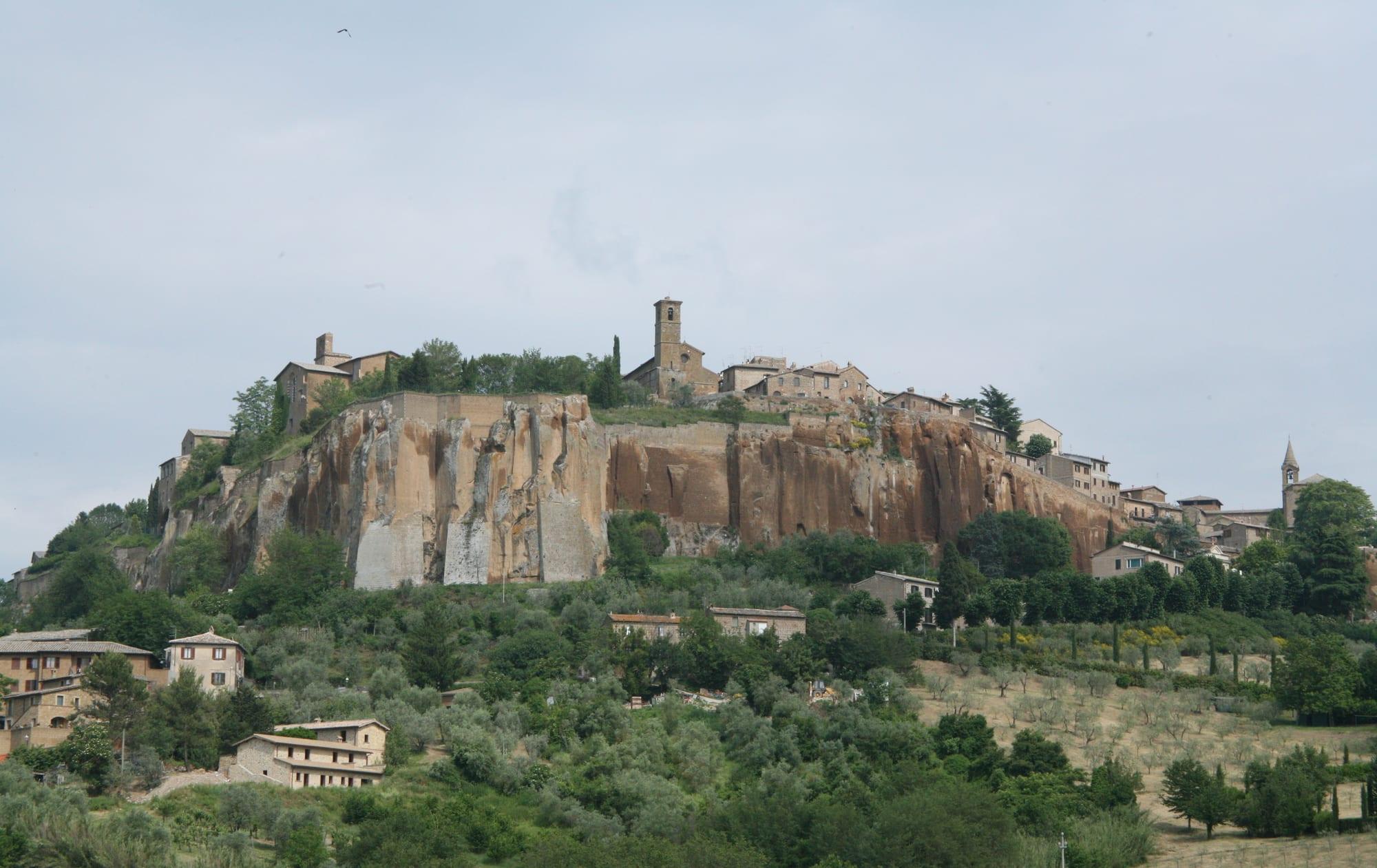
Orvieto stands on a tufa plateau, La Rupe, above the valley of the Paglia. The station is at Orvieto Scalo, below the cliff, and the funicular leaves from the square in front of it: two minutes up to Piazza Cahen, by the Pozzo di San Patrizio. The same pass works on the town bus, for 90 minutes. From the funicular, the cathedral square is about 15 minutes’ walk: along Corso Cavour for about 800 metres, then left at the Torre del Moro into Via del Duomo.
The Duomo di Orvieto, the cathedral, was begun in 1290, and its façade is banded in white travertine and black basalt. Inside, the Cappella di San Brizio was frescoed by Fra Angelico and Luca Signorelli, with scenes of the apocalypse and the Last Judgement. The €8 ticket covers the cathedral, the Museo Emilio Greco and the cathedral’s underground, with an audio guide; €11 adds the Etruscan Museo Claudio Faina. Buy it online or at the ticket office at Piazza Duomo 25, opposite the cathedral. It’s open from 9:30 to 17:00 from November to February, to 19:00 from March to May and in October, and to 20:00 from June to September. On Sundays and holy days it opens from 10:00 to 11:00 and from 13:00 to 16:30 (17:30 from March to October). There are no tourist visits during services at the high altar or in the Cappella di San Brizio, and the cathedral is closed on 1 January 2027.
The Pozzo di San Patrizio, by Piazza Cahen, is a 62-metre well that Antonio da Sangallo the Younger designed in 1527 for Pope Clement VII, with two separate spiral staircases: one for those going down for water, one for those coming back up. Beneath the town, Orvieto Underground is, in the words of Umbria’s official tourism portal, a labyrinth of caves, quarries and chambers dug over more than 2,500 years, starting with the Etruscans.
The verdict: Orvieto is the trip for a slower day: the cathedral and its chapel, the well, a long lunch, and the Intercity home.
Florence
Train: Italo, from Roma Termini or Roma Tiburtina to Firenze Santa Maria Novella, in 1 hour 25 minutes, with 32 trains a day each way; fares start at €14.90 (November 2026).
A day in Florence is enough for one great museum and a walk, not for the city. Make the museum the Uffizi. It’s open from Tuesday to Sunday, 8:15 to 18:30, with the ticket office closing at 17:30, and it’s closed on Mondays, 1 January and 25 December. Tickets (another site) carry your name: €25 if you buy on the day, €29 if you buy ahead. On a day trip, the extra €4 is worth it. Like the state sites around Rome, the Uffizi is free on the first Sunday of each month.
The verdict: go if it’s now or never for Florence. Otherwise, give it a night of its own.
The one to skip: Venice in a day
Venice is too far to do in a day from Rome. Italo’s fastest train, non-stop, takes 3 hours 34 minutes each way, so even the best day leaves over seven hours on the train, and Italo runs 11 trains a day each way. Give Venice at least one night.
What to do instead: Orvieto, from about 55 minutes by Intercity, or Florence, 1 hour 25 minutes by Italo.
The cheat-sheet
| Trip | Getting there | Fare (November 2026) | Entry | Closed |
|---|---|---|---|---|
| Tivoli | Cotral bus from Ponte Mammolo, or train to Tivoli | Cotral single by fare band (€7 from the driver) | VILLÆ Pass €30, both villas | Villa d’Este on Monday mornings |
| Ostia Antica | Metromare from Porta San Paolo | €1.50 BIT | €18, eight days | Mondays |
| Pompeii | Italo to Napoli Centrale, from 55 min, then the Circumvesuviana | Italo from €14.90 | €20, named ticket | 25 December |
| Orvieto | Intercity from about 55 min, or regional from about 1h20 | A ticket to Orvieto Centro includes the funicular | Duomo €8 | During services |
| Florence | Italo to Firenze Santa Maria Novella, 1h25 | Italo from €14.90 | Uffizi €25 on the day, €29 ahead | The Uffizi on Mondays |
| Venice | (skip as a day trip) |
A few things worth knowing
- Mondays: Ostia Antica and the Uffizi are closed, and Villa d’Este opens only at 14:00. Villa Adriana and Pompeii are open every day.
- First Sundays are free, not easy. At the Villae nothing can be booked, and free tickets are printed only at the ticket office. At Ostia the site needs no booking, but the Museo Ostiense closes. At Pompeii, the Ministry says the park may bring in timed entry.
- Winter afternoons are short. From November to January the last entry is at 15:30 at Villa Adriana and at 16:00 at Villa d’Este. At Pompeii it’s 15:30 until 15 March, and at Ostia Antica it’s 15:30, an hour before its 16:30 closing, until the end of February.
- Buy Cotral tickets before you board. From the driver, a single costs €7, cash only, with the exact money.
Pick one trip a day, and give it the whole day.
Questions
What’s the best day trip from Rome?
Tivoli, for two UNESCO villas in one day: Villa Adriana, Hadrian’s villa, in the morning, and Villa d’Este’s gardens in the afternoon. The VILLÆ Pass, €30, covers both. For the easiest trip, take Cotral’s Metromare to Ostia Antica on a €1.50 BIT.
How do you get from Rome to Pompeii?
Take Italo from Roma Termini to Napoli Centrale (the fastest trains take about 55 minutes), then EAV’s Circumvesuviana to Pompei Villa dei Misteri; check its times and fare with EAV. Entry is €20, the ticket carries your name, and in winter the last entry is at 15:30.
How do you get to Ostia Antica from Rome?
By Cotral’s Metromare train from Porta San Paolo to Ostia Antica, on an ordinary €1.50 BIT. It runs every 15 minutes from Monday to Saturday and every 20 minutes on Sundays. The site is closed on Mondays, and its €18 ticket covers all the park’s sites for eight days.
Can you see Villa d’Este and Hadrian’s Villa in one day?
Yes. Start at Villa Adriana, which opens at 8:30 every day, then take the CAT 4 or 4X bus to Tivoli station and walk to Villa d’Este. Villa d’Este opens only at 14:00 on Mondays, and from November to January its last entry is at 16:00.
Is Florence worth a day trip from Rome?
For one museum, yes. Italo takes 1 hour 25 minutes to Firenze Santa Maria Novella. Book the Uffizi (€29 ahead, or €25 on the day) and don’t go on a Monday, when it’s closed.
Which day trip from Rome should I avoid?
Venice. Italo’s fastest train takes 3 hours 34 minutes each way, which leaves over seven hours on the train in one day. Orvieto, from about 55 minutes by Intercity, or Florence make a better day.
Are the sites free on the first Sunday of the month?
The state ones are, under the Ministry of Culture’s #domenicalmuseo: Villa d’Este, Villa Adriana, Ostia Antica and Pompeii. The Uffizi is free that day too. Expect no bookings at the Villae, Ostia’s museum closed, and possible timed entry at Pompeii.
Places in this guide
See 5 of them on the mapThings to do in Rome
- Ostia Antica Day trip
- Tivoli Day trip
- Villa Adriana Sight
- Villa d’Este Sight
- Pompeii Day trip
- Orvieto Day trip
- Florence Day trip
- Villa Gregoriana Park
- SkipVenice Day trip
marks a Citorah Pick.
Plan the trip
Some of these are affiliate links: if you book through them, Citorah may earn a commission, at no extra cost to you. It never changes what the guides recommend. How Citorah is paid
About this guide
Written by Jordan Gilbert, who edits Citorah. Last checked . Prices, hours and timetables change, so check anything you’re booking against the operator’s own site. Something wrong or out of date? Tell us, or email hello@citorah.com.