Greece · Sights & tickets
The Acropolis and the Sights of Ancient Athens: Tickets, Opening Hours and Free Days
November 2026 prices and hours: the €30 Acropolis, its museum, the Ancient Agora and five more sites, the National Archaeological Museum and the free Sundays.
Checked Research-led

In this guide · 12 sections
The short version
- The Acropolis is €30, or €15 reduced, on tickets.hh.gr, the Ministry of Culture’s official ticket service, or at the ticket office. It opens at 08:00 and closes at 17:00 until 31 March 2027, then at 20:00 from April to August.
- Go at 08:00. The city’s official guide says to beat the crowds early, and never to climb it at midday in summer.
- The Acropolis Museum stays open until 22:00 on Fridays. Its official ticket site is etickets.theacropolismuseum.gr.
- Every site has its own ticket. The Acropolis, the Ancient Agora and five more Ministry sites around them come to €105 at full price.
- The Ancient Agora is €20, entered from Adrianou Street again since 30 July 2026. Its museum has been closed since 17 November 2026 by a power failure.
- The National Archaeological Museum is €20 all year. Until 30 April 2027 it closes at 15:30, except on Tuesdays, when it opens 13:00 to 20:00.
- Free Sundays. Hellenic Heritage lists free entry on the first and third Sunday of each month from November to March, such as 6 and 20 December 2026. Free tickets come only from the ticket offices.
Ancient Athens is compact. The Acropolis, its museum and the Ancient Agora sit on and around one hill, and Hellenic Heritage puts the Roman Agora and Hadrian’s Library two minutes from Monastiraki metro station. Give the National Archaeological Museum and the Panathenaic Stadium half a day each.
Prices, hours and notices are as the Ministry of Culture, the two museums and the Stadium published them on 27 November 2026. The Ministry posts its timetables on Hellenic Heritage (hh.gr), its official platform, and on odysseus.culture.gr; where the two differ, both are given. For Athens within a longer trip, see 10 days in Greece.
The Acropolis
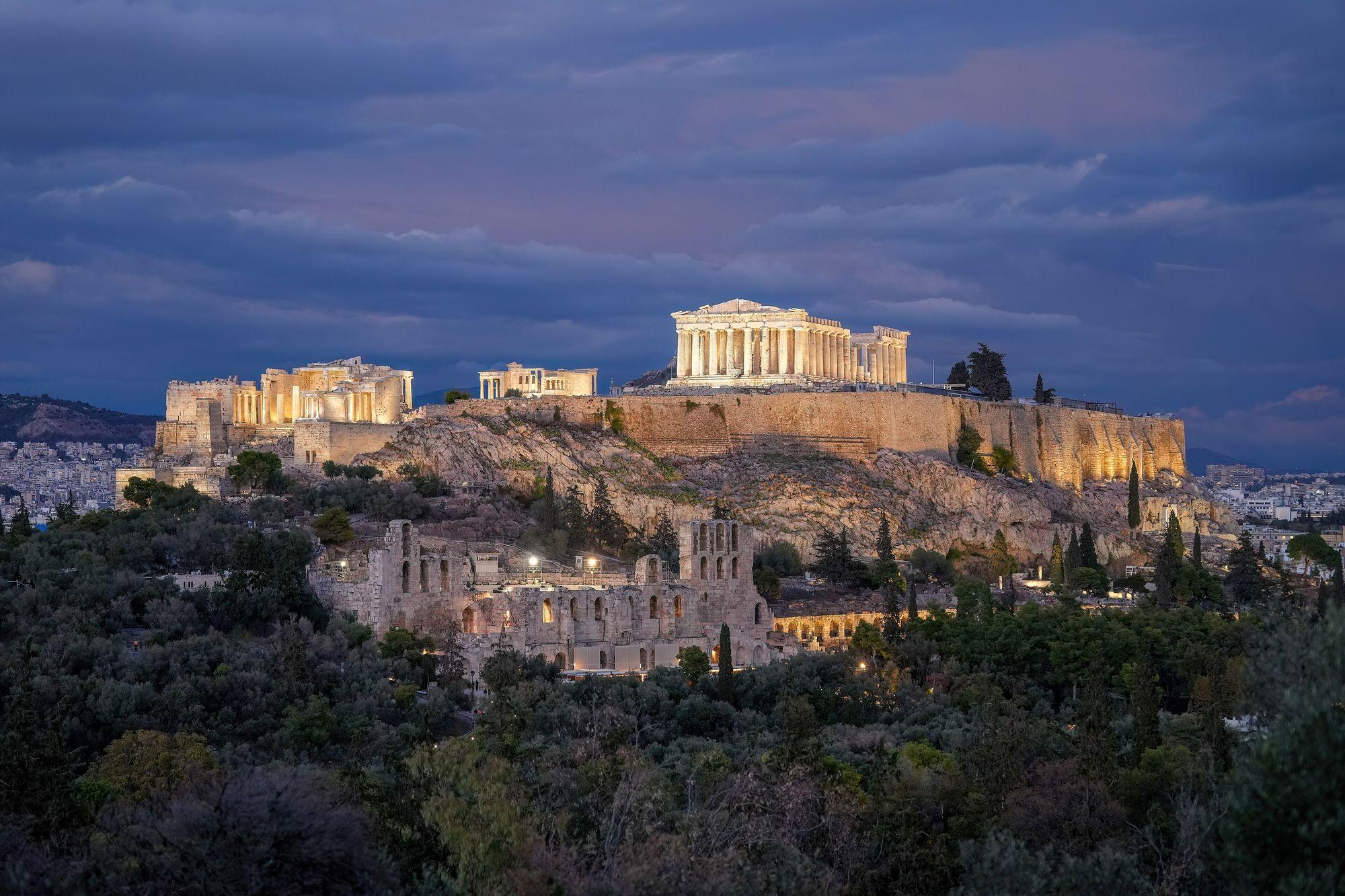
The Acropolis is the rocky hill, 156 metres above sea level, where Pericles’ building programme of the second half of the 5th century BC raised the Parthenon, the Propylaea, the Erechtheion and the Temple of Athena Nike. The porch of the Maidens, the Caryatids, belongs to the Erechtheion. The ticket also covers the slopes below. On the South Slope is the Theatre of Dionysus, which This is Athens, the city’s official guide, says is considered the world’s oldest theatre. Plan the rest of Athens around it, and book it first.
Tickets
| Ticket, November 2026 | Price |
|---|---|
| Acropolis and slopes, full | €30 |
| Reduced | €15 |
- Where to buy: online at tickets.hh.gr (another site), “the official ticket service operated by the Hellenic Ministry of Culture and ODAP”, or at the ticket offices on site, for the same price.
- Entry times: Hellenic Heritage’s terms say that where a site admits visitors by time slot, you choose it when you buy and must go in within it. You can change it twice, free, up to 120 minutes before.
- No refunds, and nothing else can be changed, unless the site is shut on the day by force majeure, when the ticket can be extended or refunded.
- Free entry, any day: EU citizens up to 25 and children up to 18 from outside the EU, with a passport or ID card, and visitors with a disability of 67% or more, with one companion. These are the Ministry’s rules for state sites, as the National Archaeological Museum publishes them.
- Reduced: EU citizens over 65, from 1 October to 31 May. Carry proof: the terms say you won’t be let in without it.
- One entry only. Once you leave the Acropolis or the South Slope, you can’t go back into either on the same ticket, so see the slopes on the same visit.
Opening hours
- 1 November 2026 to 31 March 2027: 08:00 to 17:00, every day.
- 1 April to 31 August 2027: 08:00 to 20:00.
- September and October: closing moves earlier each fortnight, to 19:30 from 1 September, 19:00 from 16 September, 18:30 from 1 October and 18:00 from 16 October.
- Last entry: 20 minutes before closing, says Hellenic Heritage; 16:30 in winter, says the Ministry’s odysseus page. Be at the gate by then.
- Closed: 1 January, 25 March, 1 May, Easter Sunday, and 25 and 26 December.
Getting in
- Getting there: metro Line 2 to Acropolis station, then about 12 minutes on foot along Dionysiou Areopagitou, or Line 1 or 3 to Monastiraki and up through Plaka. Fares are in getting around Greece.
- Two entrances: the main one on the west slope, and the South Slope’s own, at the corner of Dionysiou Areopagitou and Thrasyllou streets.
- Bags: small backpacks and handbags only. The cloakroom, north of the main entrance and outside the site, won’t take large luggage either.
- The rules: no eating or drinking, no smoking and no litter. The Ministry recommends shoes made for walking, and This is Athens warns against heels on “slippery, sensitive marble ruins”.
- Toilets: use the ones beside the main entrance; those inside were closed for renovation in November 2026.
- The lift for visitors with reduced mobility must be booked ahead, and doesn’t run in severe weather or strong winds. On 27 November 2026 it was out of order: call the guards’ office, +30 213 131 7762, an hour before you arrive.
- How long: allow two to three hours for the hill and the South Slope.
The Acropolis Museum
The Acropolis Museum, at 15 Dionysiou Areopagitou, houses the treasures of the Acropolis. Bernard Tschumi designed the glass and concrete building, which opened in 2009. On the top floor, the Parthenon Gallery sets the original sculptures beside plaster copies of those now in the British Museum. Five of the six original Caryatids are here, and Hellenic Heritage notes that the sixth, taken by Lord Elgin, is in the British Museum too. Under the building, the Excavation Museum shows an ancient Athenian neighbourhood through glass floors, and the general ticket includes it. See it after the Acropolis, not before.
- Hours, 1 November to 31 March: Monday to Thursday 09:00 to 17:00, Friday 09:00 to 22:00, Saturday and Sunday 09:00 to 20:00.
- Hours, 1 April to 31 October: the same, except that Tuesday to Thursday run until 20:00.
- Closed: 1 January, 1 May, Easter Sunday, and 25 and 26 December.
- Tickets: at etickets.theacropolismuseum.gr (another site), the “Official Acropolis Museum ticketing website”, for a set date and entry time, up to ten in one order, with no refunds. The museum sets its own prices and hours, separately from the Ministry.
- Reduced and free tickets are sold only at its ground-floor ticket desks, once your documents have been checked.
- Getting there: it’s on Dionysiou Areopagitou, the pedestrian street from Acropolis metro station up to the Acropolis.
- How long: two hours. On Fridays, its 22:00 closing is the latest of any sight here.
The Ancient Agora
The Ancient Agora, at 24 Adrianou Street, was the open square at the centre of public life in ancient Athens, bounded by three hills: the Acropolis, the Areopagus and the Agoraios Kolonos. Hellenic Heritage says nothing shows how Athenian democracy evolved better than its buildings, among them the Bouleuterion, where laws were drafted. Above them stands the Temple of Hephaestus, which it calls the best preserved temple of the 5th century BC. The Stoa of Attalos, “a covered promenade of shop stalls” in This is Athens’ words, houses the site’s museum. After the Acropolis, this is the site to see.
- Ticket: €20, or €10 reduced, for the site and its museum.
- Hours: from 08:00 every day. Hellenic Heritage gives closing at 17:00 in winter (1 November to 31 March) and at 20:00 from April to August; the Ministry’s odysseus page gives 16:30 and 19:30. The museum opens at 10:00 on Tuesdays.
- The way in: since 30 July 2026, back at 24 Adrianou Street. From July 2025, while that main entrance was rebuilt, visitors used the gate on Thiseio Square.
- The museum is shut for now. On 17 November 2026, Hellenic Heritage announced it would stay closed after a power-supply failure, until the fault is repaired. The exhibition on the Stoa’s upper floor and the Church of the Holy Apostles have been closed since 1 November 2025.
- Getting there: four minutes on foot from Monastiraki Square, or take Line 1 to Thiseio.
- How long: two hours, longer once the museum reopens.
Five more sites around the Acropolis
Each Ministry site has its own ticket. This is Athens notes that nearby sites such as the Ancient Agora and Kerameikos now need separate tickets from the Acropolis. Bought one by one at full price, the Acropolis, the Ancient Agora and these five come to €105.
| Site | Full | Reduced | Winter hours, to 31 March 2027 |
|---|---|---|---|
| Roman Agora | €10 | €5 | 08:00–15:00 |
| Hadrian’s Library | €10 | €5 | 08:00–15:00 |
| Kerameikos, site and museum | €10 | €5 | 08:00–15:00 |
| Olympieion | €20 | €10 | 08:00–15:00 |
| Aristotle’s Lyceum | €5 | €3 | 08:00–15:00 |
From 1 April to 31 August all five open 08:00 to 20:00, closing earlier in September and October like the Acropolis. The odysseus page gives the Olympieion’s winter hours as 08:30 to 15:30.
- The Roman Agora, on Dioskouron Street, two minutes from Monastiraki metro, was a marketplace paid for by Augustus and the family of Herodes Atticus between 19 and 11 BC. Its monumental gate of Athena Archegetis still stands. The Tower of the Winds is on the site, and This is Athens says it’s considered the world’s first weather station.
- Hadrian’s Library, at 3 Areos Street, also two minutes from Monastiraki metro, was inaugurated around 132 AD. Only its northern wing survives.
- Kerameikos, at 148 Ermou Street, seven minutes from Thiseio metro, was the most important cemetery of ancient Athens, in use from the Early Bronze Age to the 6th century AD. Its museum shows what was found in the tombs.
- The Olympieion, on Vasilissis Olgas Avenue, seven minutes from Acropolis metro, is the Temple of Olympian Zeus. Begun around 515 BC and finished by Hadrian in 131–132 AD, it had 104 columns, and 15 still stand. Scaffolding covers its south-east corner for conservation, and in April 2026 the Ministry said the area around Hadrian’s Gate would close for road works.
- Aristotle’s Lyceum, on Pavlou Mela Square, three minutes from Evangelismos metro, is where Aristotle taught for about twelve years; the remains of its palaestra were found in 1996. At €5, it’s the cheapest of the set.
After the Acropolis and the Agora, two or three of these are plenty.
The National Archaeological Museum
The National Archaeological Museum, at 44 Patission (28th October) Street, is the biggest museum in Greece, in Hellenic Heritage’s words. Its 11,000 exhibits date mainly from 7000 BC to AD 500. The museum calls its sculpture collection, in halls 7 to 35, “the largest and one of the most significant collections of sculpture of Greek antiquity worldwide”. The treasures from the royal tombs of Mycenae are in the Mycenaean collection, in halls 3 and 4, and upstairs, in hall 48, are the wall paintings from Akrotiri on Santorini, the “Spring Fresco” among them. If you see one museum in Athens besides the Acropolis Museum, make it this one.
Until the end of January 2027, Pylos of Nestor. A Mycenaean Kingdom Revealed shows 214 antiquities from Messenia, and 11 of the museum’s own, on the kingdom traditionally associated with Homer’s Nestor.
- Ticket: €20, or €10 reduced. The museum says its price stays the same all year.
- Hours until 30 April 2027: Wednesday to Monday 08:30 to 15:30, last admission 15:00; Tuesday 13:00 to 20:00.
- From 1 May 2027: Wednesday to Monday 08:00 to 20:00, and Tuesday 13:00 to 20:00.
- Closed: 25 and 26 December, 1 January, 25 March, 1 May and Orthodox Easter Sunday.
- Free: on the Ministry’s free days below, winter Sundays included, as its visiting page (another site) lists them.
- Getting there: eight minutes on foot from Victoria metro station, on Line 1, or 12 from Omonia.
- When to go: in winter, Tuesday is the one day it’s open after 15:30, and it’s shut on Tuesday mornings. Give it at least two hours.
The Panathenaic Stadium
The Panathenaic Stadium, the Kallimarmaro, on Vasileos Konstantinou Avenue across from the statue of the Discobolus, is the stadium of the first modern Olympic Games, in 1896. The orator Lycurgus built a stadium here in 330/329 BC, and Georgios Averoff paid for its marble renovation for 1896. It’s still the finish of the Athens Marathon. You can run onto the field, see the museum of Olympic posters and torches, and climb to Section 21’s upper bleachers for what the Stadium calls a breathtaking view, from the Acropolis to Lycabettus Hill. For anyone who likes sport, it’s the best-value hour in the city.
- Tickets: €12, or €6 for students with a student card, since 1 October 2025. Children up to 6 go free. The ticket includes the museum and an audio guide of about 30 minutes.
- Buying: at the ticket desk, by cash or card, or at tickets.panathenaicstadium.gr (another site), the Hellenic Olympic Committee’s ticket site. A ticket is valid only on the day it’s issued, and can’t be refunded.
- Hours: 08:00 to 17:00 from November to February, and 08:00 to 19:00 from March to October. In winter, online sales stop at 16:30 and the box office at 17:00.
- In summer, the Stadium recommends the morning or late afternoon, when it’s cooler, with water and sun cream.
- Check its visit page (another site) first. Events close parts of it. Marble cleaning, begun on 10 August 2026, is due to end within 2026.
- Getting there: about 1,000 metres from Syntagma, Acropolis and Evangelismos metro stations. Tram line 6 stops at Zappeio.
Outside the gates: the promenade, the hills and the guard
- Dionysiou Areopagitou, the paved promenade along the foot of the Acropolis, was closed to traffic in 2003 and links Hadrian’s Arch to Philopappou Hill. This is Athens lists a stroll along it among its free things to do.
- Areopagus Hill, a rock about 300 metres west of the Acropolis, has what This is Athens calls the best view of the Acropolis and the city. Its steps are worn smooth, so wear trainers.
- The Pnyx, the hilltop clearing where the Athenian assembly met, is This is Athens’ free pick for sunset, with views of the Parthenon through the pines.
- The changing of the guard outside Parliament on Syntagma Square happens every hour, on the hour, and costs nothing. On Sundays at 11:00, the evzones, the Presidential Guard, are in full traditional dress.
Free days, and who pays less
- Fixed dates: 6 March, 18 April, 18 May, the last weekend of September and 28 October, at the Acropolis, the other Ministry sites here and the National Archaeological Museum.
- Winter Sundays: Hellenic Heritage and the National Archaeological Museum also list the first and third Sunday of each month from 1 November to 31 March. In winter 2026-27 that’s 6 and 20 December, 3 and 17 January, 7 and 21 February, and 7 and 21 March. The Ministry’s odysseus pages list only the fixed dates, and This is Athens only the first Sunday, so check hh.gr before planning around a third Sunday.
- On free days, tickets are issued only at the ticket offices, not online.
- The Acropolis Museum and the Stadium have their own rules.
Planning: what goes together
| Place | Full price | Hours, November 2026 to March 2027 |
|---|---|---|
| Acropolis and slopes | €30 | 08:00–17:00 |
| Acropolis Museum | Set by the museum | Mon to Thu 09:00–17:00, Fri 09:00–22:00, Sat and Sun 09:00–20:00 |
| Ancient Agora | €20 | From 08:00, closing 16:30 or 17:00 |
| Roman Agora, Hadrian’s Library, Kerameikos | €10 each | 08:00–15:00 |
| Olympieion | €20 | 08:00–15:00 |
| Aristotle’s Lyceum | €5 | 08:00–15:00 |
| National Archaeological Museum | €20 | Wed to Mon 08:30–15:30, Tue 13:00–20:00 |
| Panathenaic Stadium | €12 | 08:00–17:00 |
- A first day: the Acropolis at 08:00, as This is Athens advises, to beat the crowds; down through the South Slope; then along Dionysiou Areopagitou to the Acropolis Museum.
- A second morning: the Ancient Agora at 08:00, then the Roman Agora and Hadrian’s Library. In winter the smaller sites close at 15:00, so see them before lunch.
- The National Archaeological Museum on a morning of its own, or a winter Tuesday afternoon.
- The Olympieion and the Panathenaic Stadium go together from Acropolis metro station.
For rooftops with an Acropolis view, see the Athens nightlife guide; for a base in Plaka or Koukaki, where to stay in Greece; and for lunch between sites, where to eat in Greece.
What to skip
- The Acropolis in the middle of a summer day. This is Athens is blunt: “Don’t try to climb the Acropolis in the middle of the day during the summer. No sunscreen can save you from heatstroke.” It suggests early morning, or just before sunset. Greece’s weather service, HNMS, puts the average daily high in Athens at 32.4°C in July and August, and on hot days the Ministry can close sites at midday, as it did at eight sites on Crete on 22 July 2026.
- Tickets from anyone but the official sellers, and sites that only look official. The Acropolis Museum’s ticket site warns that the museum “is not responsible for third-party tickets that may be charged at higher prices”. Hellenic Heritage’s terms say a Ministry ticket is valid only if sold by an official point of sale, and ban the resale of tickets. The Acropolis is €30 online or at the ticket office, so there’s no reason to pay more for entry alone. Type the address yourself: tickets.hh.gr, which the Ministry’s own pages point to; etickets.theacropolismuseum.gr; and tickets.panathenaicstadium.gr.
- The Odeon of Herodes Atticus, for now. This is Athens reported on 7 August 2026 that the 2nd-century AD odeon on Dionysiou Areopagitou was closing for a three-year restoration.
A few things worth knowing
- Closures at short notice. The Ministry posts them on Hellenic Heritage’s announcements page (another site). Kerameikos, the Roman Agora and Aristotle’s Lyceum closed on Monday 23 November 2026, Kerameikos again on 25 November, and the Acropolis shut from 17:00 on 1 April 2026 because of the weather. Check the page on the morning you go.
- Early May 2027. May Day and Orthodox Easter Sunday fall on Saturday 1 and Sunday 2 May, and the Ministry’s sites and both museums close on both days.
- Pickpockets. The UK’s FCDO says thefts of passports, wallets and handbags are common on the metro and in crowded tourist places, particularly in central Athens.
Questions
How much is the Acropolis ticket in 2026?
€30, or €15 reduced, in November 2026, for the Acropolis and its slopes, on tickets.hh.gr or at the ticket office. EU citizens up to 25 and children up to 18 from outside the EU go free with a passport or ID card.
What time does the Acropolis open and close?
It opens at 08:00 every day. Until 31 March 2027 it closes at 17:00, and from 1 April to 31 August at 20:00. Last entry is 20 to 30 minutes before closing, depending on which of the Ministry’s two sites you read.
When is the Acropolis free?
On 6 March, 18 April, 18 May, the last weekend of September and 28 October. Hellenic Heritage also lists the first and third Sunday of each month from November to March, such as 6 and 20 December 2026. Free tickets are issued only at the ticket offices.
Is there a combined ticket for the Acropolis and the other sites?
Each site has its own ticket on the Ministry’s pages, and This is Athens notes that the Ancient Agora and Kerameikos now need separate tickets. Bought one by one, the Acropolis and six nearby sites come to €105 at full price.
Plan the trip
Some of these are affiliate links: if you book through them, Citorah may earn a commission, at no extra cost to you. It never changes what the guides recommend. How Citorah is paid
About this guide
Written by Jordan Gilbert, who edits Citorah. Last checked . Prices, hours and timetables change, so check anything you’re booking against the operator’s own site. Something wrong or out of date? Tell us, or email hello@citorah.com.