Málaga · Where to stay
Where to Stay in Málaga: A Neighbourhood-by-Neighbourhood Guide
Where to base yourself in Málaga: the old town, Soho, La Merced, La Malagueta and the port, the station area and Pedregalejo, with the hotels in each and when rates are lowest.
Checked Research-led

In this guide · 11 sections
The short version
- Centro Histórico: the old town of the cathedral, the Alcazaba and Calle Larios. The first-trip base.
- Soho: the street-art district between the Alameda and the port.
- La Merced: the square where Picasso was born, with small hotels in the streets around it.
- La Malagueta and the port: the beach, Muelle Uno and the five-stars on Paseo de Reding.
- Around María Zambrano station: for early trains. Practical rather than pretty.
- Pedregalejo and El Palo: the old fishing districts to the east, for the beach. Thin hotel choice.
- Cheapest months: January and February, on INE’s figures.
To see what’s free on your dates first, this is an affiliate link: if you book through it, Citorah may earn a commission, at no extra cost to you, and it doesn’t change what this guide recommends. Search every stay in Málaga on Booking.com Affiliate link, then use the neighbourhood sections below to narrow it down.
Málaga’s sights sit close together. Spain’s tourism board, spain.info, notes that most of them are in the city centre, close enough to see on foot. So the choice is less about distance than about what you want outside the door: old streets, the beach, or a train.
Below are six areas, and the hotels worth knowing in each. The star ratings come from the Junta de Andalucía’s tourism register, which the regional government publishes as open data and last updated on 21 October 2026. There’s no price table, because hotels only show live rates for your dates. Málaga’s seasons are predictable, though, so start there.
When Málaga is cheapest
Spain’s statistics office, INE, publishes the average daily rate in the city of Málaga’s hotels every month, across all categories.
In 2025, the cheapest month was January, at €110.18 a night, followed by February (€113.10) and November (€123.39). The dearest was May, at €152.39, with August (€150.41) and September (€150.26) close behind. January came in about 28% below May.
Rates rose in 2026. January 2026 averaged €119.63, against €110.18 a year earlier, and August 2026 averaged €163.05, against €150.41 in August 2025. INE’s figures from September 2025 onwards are still provisional.
So for the lowest rates, come in January or February.
1. Centro Histórico: the first-trip base
The old centre is where the sights are. The Andalusian tourist board’s tour of it takes in “the imposing Cathedral; the Nazari Gibralfaro Castle; La Alcazaba fortress, renovated for public usage; and the Roman Theatre”. Its best-known street is Calle Marqués de Larios, or simply Calle Larios, which starts by the port at Plaza de la Marina and is lined with shops.
Stay here for a first trip, or a short one: most of the sights are a walk away. The beach isn’t (see “What to skip”).
Who it suits: first-timers; short stays; museum-focused trips; couples.
Who it doesn’t: beach holidays; anyone who wants quiet streets at night.
The hotels worth knowing:
- Palacio Solecio: a four-star in an 18th-century Andalusian palace on Calle Granada, in the old Jewish quarter (La Judería), opposite the Iglesia de Santiago and a few steps from the Picasso Museum and the cathedral. Its restaurant, Balausta, is run by the chef Sergio Solano. The Michelin Guide lists it.
- Vincci Larios Diez: a four-star on Calle Marqués de Larios itself, with a rooftop with views. Some of its rooms look onto Calle Larios. The Michelin Guide lists it too.
- Hotel Catalonia Molina Lario: a four-star in the historic centre, a step from Calle Larios. Its rooftop has an outdoor pool, a solarium and a bar, with views of the port and the cathedral, and it’s open all year round. Most of its junior suites look onto the cathedral from their balconies.
- Vincci Selección Posada del Patio: a five-star on Pasillo de Santa Isabel, which says it’s the only hotel with views of the city’s ancient Roman and Arab walls. The Michelin Guide, which lists it, notes glass panels in the lobby over the ruins of the old walls, and a rooftop with a plunge pool.
2. Soho: street art by the port
spain.info describes Soho, or the Art District, as a central district and “symbol of urban art and underground culture in the city of Málaga”. It’s known for its large murals, including works by Obey and D*face. It lies next to the port, bordered by the southern edge of the Alameda, the Heredia Wharf, Plaza de la Marina and the Guadalmedina river.
Its cultural venues include private galleries, artists’ studios and the La Alameda Theatre. The Soho Urban Market, with more than fifty local artisans, designers and producers, is held on the fourth Sunday of every month.
It’s a good base if you want to be central but away from the busiest old-town streets, and its edge at Plaza de la Marina puts you between Calle Larios and the port.
Who it suits: return visitors; art-minded trips; anyone who wants the centre without the crowds of Calle Larios.
Who it doesn’t: travellers who want the monuments on the doorstep (spain.info puts them very close, but they’re not in Soho itself).
The hotels worth knowing:
- Only YOU Hotel Málaga: a five-star in La Equitativa building, facing the port at the start of Calle Marqués de Larios. Its rooftop, Lolita Sky View, Pool & Lounge, has an infinity pool, and Sonora Sky & Bites is on the 7th floor.
- Room Mate Collection Valeria (registered as Room Mate Valeria): a four-star design hotel at Plaza del Poeta Alfonso Canales 5, on the corner of Plaza de la Marina, next to the Palmeral de las Sorpresas and Muelle Uno. Its rooftop, La Terraza de Valeria, has a pool and views of the sea and the port.
- Soho Boutique Bahía Málaga: a four-star on Calle Somera. The chain pitches it at people who want the food, the culture, the beach and the nightlife without much travelling.
3. La Merced: Picasso’s square
Above the old centre is Plaza de la Merced, which the Andalusian tourist board describes as the “site of the house in which the artistic genius Picasso was born”. Hotel Del Pintor calls the streets around it the “Barrio de Picasso”, steps from the Picasso Museum, the Roman Theatre and Alcazaba, and the Museo de Málaga in the Palacio de la Aduana.
It’s the calmer edge of the centre, and its small hotels have more character for the money than most of the old town’s.
Who it suits: couples; returning visitors; anyone who wants the old town on foot without sleeping on its busiest streets.
Who it doesn’t: beach-first trips; travellers who want a big hotel with a pool.
The hotels worth knowing:
- Hotel Del Pintor: a three-star boutique hotel at Calle Álamos 27. It’s about 3 kilometres from María Zambrano station, by its own account.
- Hotel Palacete de Álamos: a four-star boutique hotel at Calle Álamos 20, in a late-19th-century building that keeps one of the few surviving stretches of the old medieval city wall. It has a spa and apartments as well as hotel rooms.
- Well & Come Málaga: a four-star boutique hotel at Calle Madre de Dios 19, registered at the end of 2024. Its rooftop looks out over the Alcazaba and the cathedral, and it has a spa and a 24-hour gym.
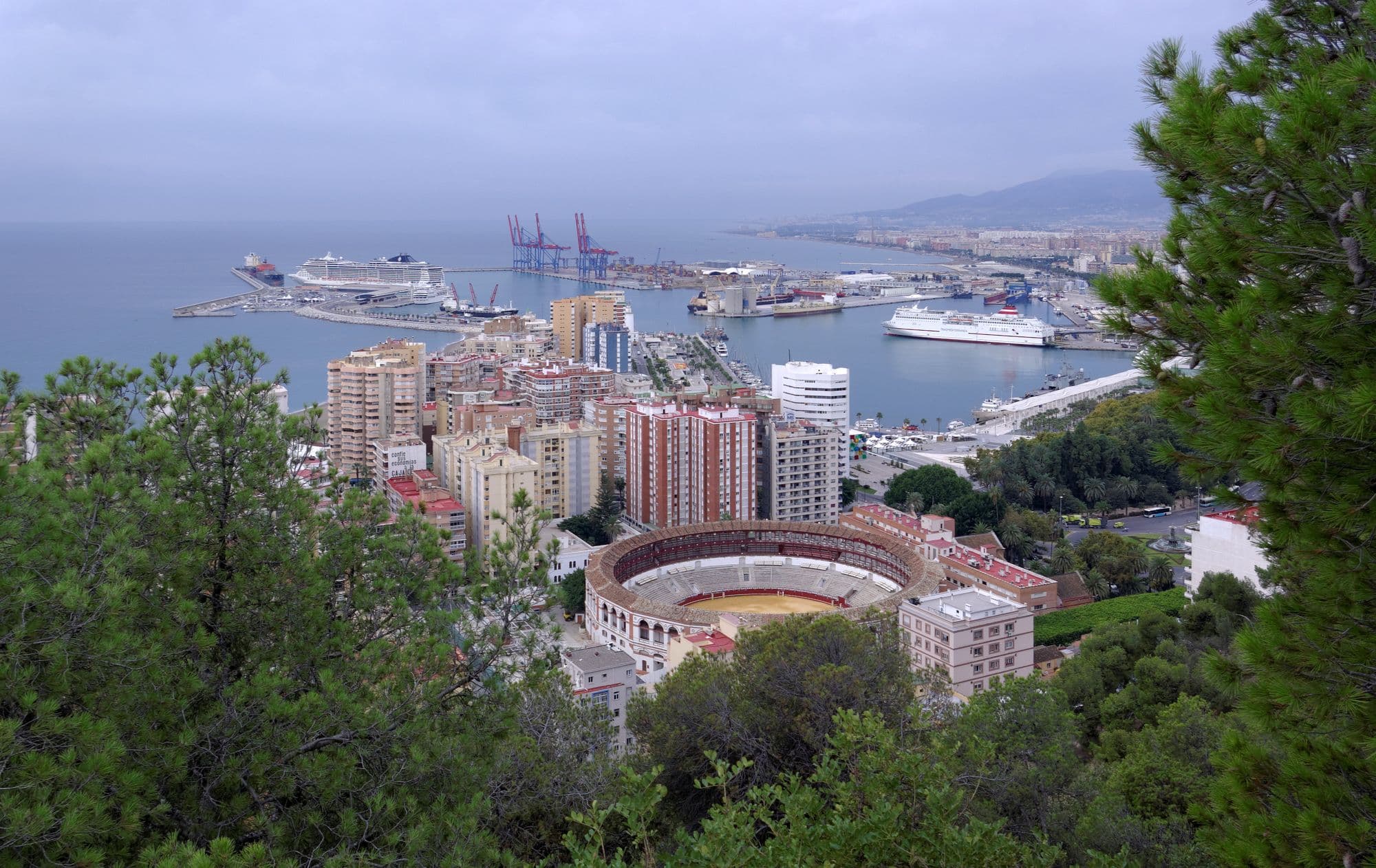
4. La Malagueta and the port: the beach, Muelle Uno and the grand hotels
The Andalusian tourist board’s tour of the city runs along “the city’s main promenade, the Paseo Maritimo, with its beaches, La Malagueta district, the lighthouse (which has become the symbol of the city)”. The beaches guide covers La Malagueta beach itself.
Beside the district is the port’s leisure front. Muelle Uno, which opened in 2011, runs alongside the Paseo de la Farola, with shops and restaurants at the water’s level and a promenade above. The Centre Pompidou Málaga is there, the first Centre Pompidou outside France. The Palmeral de las Sorpresas, a walk under palms and a long pergola beside the Paseo de los Curas, opened in 2011 too.
This is the base for a beach holiday that still wants the city: the old town is a walk one way, the sand a walk the other.
Who it suits: beach-and-city trips; families; couples on a luxury break.
Who it doesn’t: travellers on a tight budget (the hotels below are all four- and five-stars).
The hotels worth knowing:
- Gran Hotel Miramar: a five-star gran lujo (grand luxury) hotel on Paseo de Reding, overlooking the Bay of Málaga. It opened in 1926 as the Hotel Príncipe de Asturias, inaugurated by King Alfonso XIII, later became a courthouse, and was restored as a hotel by Hoteles Santos. It has 190 rooms, two outdoor pools, a sea-view chill-out area for over-16s and the Botanic Spa by Sisley. The Michelin Guide lists it.
- Áurea Palacio de la Tinta: a five-star at Paseo de Reding 20, in a modernist building from 1908 by Julio O’Brien that was long the headquarters of the Andalusian Railway Company. It has 141 rooms, the Asador Contrapunto grill and the La Danza rooftop bar. It’s new: the Junta’s register dates it from 23 April 2026.
- Hotel MS Maestranza Málaga Centro: a four-star at Avenida Cánovas del Castillo 1, beside the bullring and opposite Muelle Uno, about 100 metres from La Malagueta beach. All 94 rooms have terraces, and its Relax Area has a sauna, a Turkish bath, a jacuzzi and a sun terrace.
- Soho Boutique Castillo de Santa Catalina: a five-star “recommended for adults” in El Limonar, at Calle Ramos Carrión 38, in a palace built in 1932 in a style inspired by the Arab Renaissance, looking out over the Bay of Málaga.
5. Around María Zambrano station: for early trains
María Zambrano is Málaga’s high-speed (AVE) station. The airport commuter train stops there too, and spain.info says it reaches the city centre in under 15 minutes. The getting-around guide has the timetables and fares.
The streets around the station are practical rather than pretty. Stay here if your trip runs on trains, or if you’re catching an early one at the end of it. Otherwise, sleep in the old town and walk in.
Who it suits: early trains; short stopovers; anyone moving on by rail.
Who it doesn’t: anyone who wants a neighbourhood to wander in the evening.
The hotels worth knowing:
- Barceló Málaga: a four-star in the station complex, with direct access to the AVE station. It has 221 rooms, a rooftop pool and solarium on the 8th floor (B-Heaven), and a huge steel slide from the first floor down to the lobby.
- Eurostars Málaga: a four-star with 154 rooms at Calle Héroe de Sostoa 17, next to the high-speed station.
- Casual del Mar Málaga: a three-star at Avenida de la Aurora 9. The hotel says the station is “a dos pasos” (a stone’s throw) and Calle Larios 700 metres away.
6. Pedregalejo and El Palo: the old fishing districts
The Andalusian tourist board describes “the suburb of El Palo, with its typical fishermen’s houses, coves, promenades” and fried fish, in the east of the city. Hotel La Chancla calls neighbouring Pedregalejo Málaga’s traditional fishing quarter, and Hostal Moscatel sums it up as one of the city’s most popular beaches, with a seafront promenade and a great many restaurants and chiringuitos (beach bars).
This is the beach base: swim in the morning and take the bus in for the sights. EMT bus line 11 runs between El Palo and the Alameda Principal, in the centre, and the night bus N1 covers the same ground.
Choice is thin here. The two places below are small, with nine and ten rooms.
Who it suits: beach-first trips; return visitors; longer stays.
Who it doesn’t: first-timers who want the sights on foot; anyone who needs a big hotel’s services.
The hotels worth knowing:
- Hotel La Chancla: a three-star on Pedregalejo’s seafront promenade. It says it’s the only hotel in Málaga right on the beach, a few metres from the water. The Andalusian tourist board lists nine rooms, a sun terrace with a whirlpool, and a sauna, and the hotel has a beachfront restaurant.
- Hostal Moscatel: a family-run two-star hostal at Calle Conde de las Navas 9, in Pedregalejo, with 10 rooms in a traditional Andalusian house. It accepts pets.
How to choose, in one line each
- First trip, central? Centro Histórico.
- Central, but calmer? La Merced, or Soho.
- Beach and city together? La Malagueta.
- Beach first, sights second? Pedregalejo.
- Luxury? La Malagueta, on Paseo de Reding.
- An early AVE? Around María Zambrano.
What to skip
- The old town for a beach holiday. It’s close to the sea, not on it. The Michelin Guide puts the Catalonia Puerta del Mar, by the old town, a 20-minute walk from La Malagueta beach. If the beach is the point, base at La Malagueta or Pedregalejo.
- The airport hotels for a city break. Hotels named for the airport, such as the Travelodge Málaga Aeropuerto (Avenida Velázquez 212) and the Holiday Inn Express Málaga Airport (Avenida Velázquez 290), suit a dawn flight, not a stay in Málaga.
- Reading “Soho” in a hotel name as an address. Soho Boutique is a hotel chain, and its Málaga hotels aren’t all in Soho: the Castillo de Santa Catalina is in El Limonar, and the Soho Boutique Los Naranjos is on Paseo de Sancha. Check the street before you book.
A few things worth knowing
- Hotels carry a register number. Several of the hotels above show their Junta de Andalucía tourism-register (RTA) number on their websites: Palacio Solecio’s is H/MA/02275. The register gives each hotel’s official category.
- Rooftop pools are common. Molina Lario’s is open all year round. Elsewhere, check before booking a winter trip for the pool: Gran Hotel Miramar warns that its pool hours may change.
- Book early for the big weeks. The Andalusian tourist board picks out the city’s “spectacular Holy Week and grandiose Fair”, and the Fair is in August. August 2026 averaged €163.05 a night, on INE’s provisional figures, against €119.63 in January.
- The airport is close. The commuter train reaches the city centre in under 15 minutes, and stops at María Zambrano.
Pick the right base. Málaga works out from there.
Questions
Which area is best to stay in Málaga?
The Centro Histórico for a first trip; La Merced or Soho for somewhere central but calmer; La Malagueta for the beach and the port; Pedregalejo for a beach-first stay.
Where should I stay in Málaga for the first time?
The Centro Histórico, the old town of the cathedral, the Alcazaba and Calle Larios. Most of the city’s sights are within walking distance.
Where should I stay in Málaga for the beach?
La Malagueta, where Hotel MS Maestranza, for example, is about 100 metres from the beach, or Pedregalejo and El Palo to the east, linked to the centre by EMT bus line 11.
Is it worth staying near María Zambrano station?
Only if your trip runs on trains. Barceló Málaga has direct access to the AVE station, and the airport commuter train stops there too. For evenings, the old town is better.
When are Málaga hotels cheapest?
January and February. In 2025, INE’s average daily rate for the city’s hotels was €110.18 in January and €113.10 in February, against €152.39 in May, the dearest month.
Places in this guide
All of MálagaWhere to stay in Málaga
- Palacio Solecio Hotel · Centro Histórico
- Vincci Larios Diez Hotel · Centro Histórico
- Catalonia Molina Lario Hotel · Centro Histórico
- Vincci Selección Posada del Patio Hotel · Centro Histórico
- Only YOU Hotel Málaga Hotel · Soho
- Room Mate Collection Valeria Hotel · Soho
- Soho Boutique Bahía Málaga Hotel · Soho
- Hotel Del Pintor Hotel · La Merced
- Hotel Palacete de Álamos Hotel · La Merced
- Well & Come Málaga Hotel · La Merced
- Gran Hotel Miramar Hotel · La Malagueta and the port
- Áurea Palacio de la Tinta Hotel · La Malagueta and the port
- Hotel MS Maestranza Málaga Centro Hotel · La Malagueta and the port
- Soho Boutique Castillo de Santa Catalina Hotel
- Barceló Málaga Hotel · María Zambrano
- Eurostars Málaga Hotel · María Zambrano
- Casual del Mar Málaga Hotel · María Zambrano
- Hotel La Chancla Hotel · Pedregalejo and El Palo
- Hostal Moscatel Hotel · Pedregalejo and El Palo
- SkipTravelodge Málaga Aeropuerto Hotel
- SkipHoliday Inn Express Málaga Airport Hotel
Where to eat in Málaga
- Balausta Restaurant · Centro Histórico
- Soho Urban Market Market · Soho
Bars and nights out in Málaga
- La Terraza de Valeria Rooftop bar · Soho
Things to do in Málaga
- Alcazaba Sight · Centro Histórico
- Roman Theatre Sight · Centro Histórico
- Museo de Málaga Museum
- Centre Pompidou Málaga Museum · La Malagueta and the port
- Muelle Uno Sight · La Malagueta and the port
- La Malagueta Beach · La Malagueta and the port
- Pedregalejo Beach · Pedregalejo and El Palo
- El Palo Beach · Pedregalejo and El Palo
- Calle Granada Sight
- Plaza de la Merced Sight · La Merced
- Calle Larios Sight · Centro Histórico
- Palmeral de las Sorpresas Park · La Malagueta and the port
marks a Citorah Pick.
Plan the trip
Some of these are affiliate links: if you book through them, Citorah may earn a commission, at no extra cost to you. It never changes what the guides recommend. How Citorah is paid
About this guide
Written by Jordan Gilbert, who edits Citorah. Last checked . Prices, hours and timetables change, so check anything you’re booking against the operator’s own site. Something wrong or out of date? Tell us, or email hello@citorah.com.