Málaga · Itineraries
3 Days in Málaga: The Old Town, the Museums, the Beach and a Day Trip, Day by Day
A three-day Málaga plan: Gibralfaro, the Alcazaba and a market lunch, then Picasso, the port and espetos by the sea, then the Caminito del Rey or Nerja. With October 2026 hours and prices.
Checked Research-led

In this guide · 7 sections
The short version
- Day 1: up to the Castillo de Gibralfaro, down through the Alcazaba to the Roman Theatre, lunch at the Atarazanas market, then the Cathedral.
- Day 2: the Museo Picasso Málaga, then Muelle Uno and the Centre Pompidou, then La Malagueta and espetos, sardines grilled on a skewer, in Pedregalejo.
- Day 3: the Caminito del Rey, by Renfe regional train to El Chorro, or a bus to Nerja and its cave.
- Book one thing: the Caminito del Rey, €10, on its official site. It’s closed on Mondays, apart from a few special dates.
- Check the day: the Roman Theatre is closed on Mondays and the Centre Pompidou on Tuesdays, and the Atarazanas market is a morning market. On Sundays, the Cathedral opens to visitors only from 14:00.
- Pair this with where to stay in Málaga: an old-town base keeps the first two days on foot.
Málaga’s main sights sit close together. The Museo Picasso Málaga describes itself as “very close to the Cathedral, the Alcazaba and the Roman Theatre”, so two days cover the city: one for the hill and the old town, one for the art, the port and the beach. The third is for a day out of town.
The hours, prices and rules below are as the sights, the operators and the city published them in October 2026. Several change with the season, so check before you go.
Before you go
When to go. Summer is hard work for a castle climb and a gorge walk. AEMET, Spain’s weather agency, gives Málaga airport’s average daily high for 1981 to 2010 as 30.5°C in July and 30.8°C in August, against 24.3°C in May and 24.1°C in October. The wet months are November and December, at 100 mm of rain each on average. Spring and autumn suit this plan best. The Feria de Málaga, the city’s August fair, ran from Friday 14 to Saturday 22 August in 2026, with nearly 200 shows, the city council says.
Where to stay. Where to stay in Málaga covers the neighbourhoods. To see what’s free on your dates first, this is an affiliate link: if you book through it, Citorah may earn a commission, at no extra cost to you, and it doesn’t change what this guide recommends. Search every stay in Málaga on Booking.com Affiliate link, then use the neighbourhood guide to narrow it down.
Book ahead.
- The Caminito del Rey. Book on the official site: the operator’s 2026 rules name it as the official sales channel. Day 3 has the details.
- The Museo Picasso Málaga. All its tickets are sold online, and the museum says to buy online “to make sure you get your ticket”.
Pick your days.
- Day 1: Tuesday to Saturday. The Roman Theatre is closed on Mondays and the market on Sundays, when the Cathedral opens to visitors only from 14:00 to 18:00.
- Day 2: not a Tuesday, when the Centre Pompidou is closed.
- Day 3: not a Monday, when the Caminito del Rey is usually closed.
A Wednesday-to-Friday, Thursday-to-Saturday or Friday-to-Sunday trip fits all three.
Check before you travel: seasonal hours and closures
The Cathedral’s rooftop tours are suspended because of works on the roof, its site says. The Alcazaba and Gibralfaro switch to winter hours on 1 November, closing at 18:00, and the Museo Picasso Málaga closes at 18:00 from November to February. The Caminito del Rey can close for rain or strong wind: check its site the morning you go.
Day 1: Gibralfaro, the Alcazaba, the Roman Theatre and the Cathedral
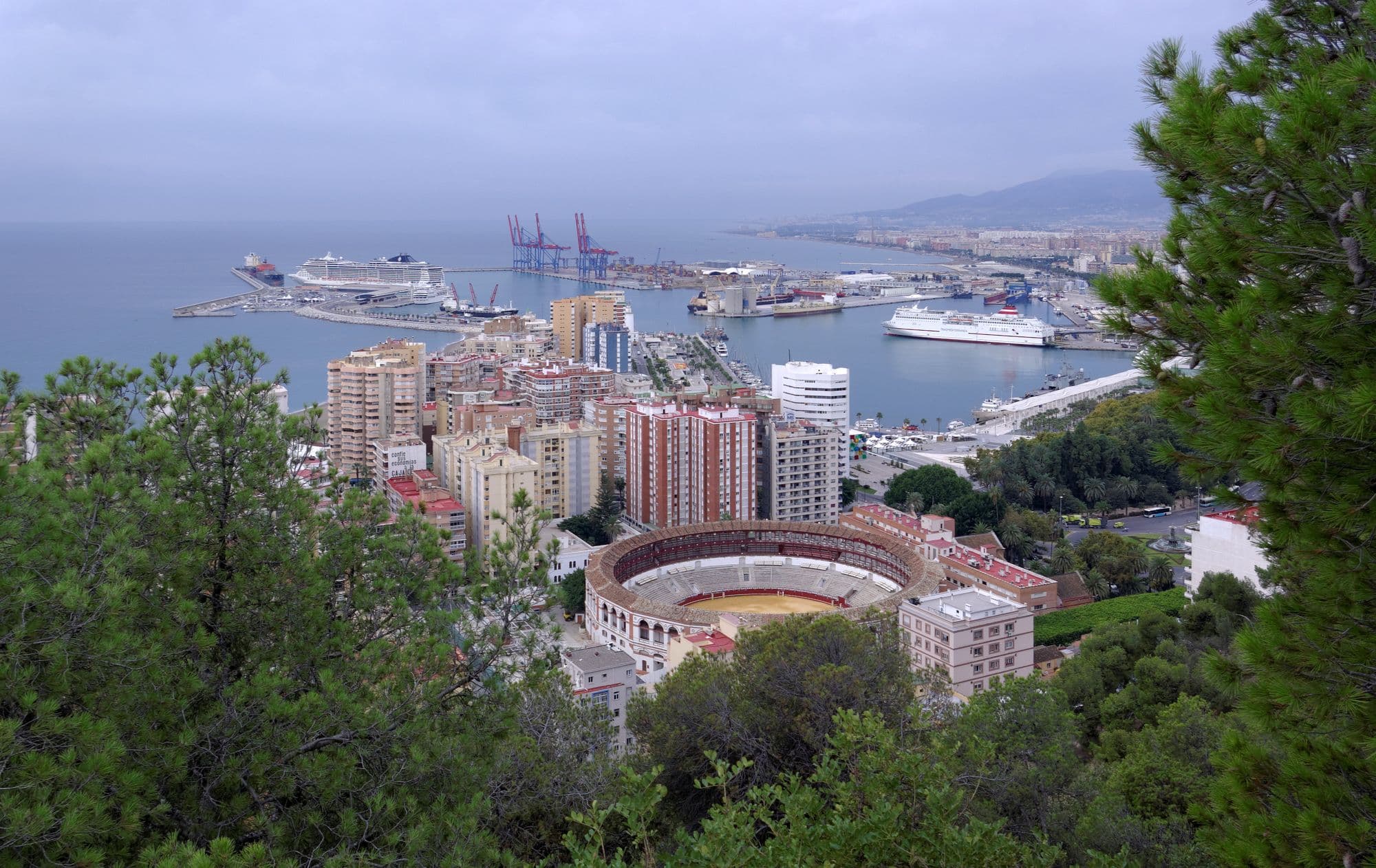
Morning: up the hill first, while it’s cool. EMT bus 35 runs between the historic centre and the Castillo de Gibralfaro about every 30 minutes, the city’s monuments site says, or you can walk up the Paseo de Don Juan Temboury in about 20 minutes. The castle, at Camino de Gibralfaro 11, was built in the 14th century to house troops and protect the Alcazaba below. It stands on the crest of a hill 132 metres above sea level, and from it, in the city’s words, you look over “toda la ciudad y la bahía”: the whole city and the bay.
Walk back down to the Alcazaba, at Calle Alcazabilla 2. The city council calls it one of the most important defensive complexes preserved in Spain. It was built in the Islamic period as a fortress, then became a palace-fortress and the seat of the city’s government. Allow an hour: the visit takes in two walled enclosures and the fortified gates in front of them.
- Hours: both monuments open from 9:00 to 20:00 until 31 October, with last entry at 19:00, and from 9:00 to 18:00 from 1 November to 31 March, with last entry at 17:00.
- Tickets (October 2026): a general ticket costs €7, and a combined ticket for the Alcazaba and Gibralfaro €10. Entry is free for everyone on Sundays from 14:00.
Late morning: the Roman Theatre. The Teatro Romano is on Calle Alcazabilla, on the slope below the Alcazaba. It was built in the first years of the 1st century AD and, the Junta de Andalucía says, lay hidden for centuries under the streets and houses on the hillside, until gardening works in 1951 uncovered it. Entry is free, and there’s an interpretation centre. It opens from Tuesday to Saturday, 10:00 to 18:00, and on Sundays and public holidays from 10:00 to 16:00, with no entry in the last 30 minutes. It’s closed on Mondays.
Lunch: the Atarazanas market. The Mercado Central de Atarazanas, at Calle Atarazanas 10, is the largest of the city’s municipal markets, with 260 stalls. Its iron-framed hall was built between 1876 and 1879 by the architect Joaquín de Rucoba, on the site of 14th-century Nasrid shipyards, whose marble gateway was moved to the middle of the main façade. The council says locals and visitors come every day to buy fresh produce or to tapear pescaíto: to eat fish as tapas. Under the city’s markets ordinance, its stalls must open from 8:30 to 14:30, so get there by 14:00.
Afternoon: the Cathedral. Málaga Cathedral, the Santa Iglesia Catedral Basílica de la Encarnación, was built over the city’s main mosque, and opened for worship in its present form in 1768. Its north tower rises to 87 metres. The south tower is unfinished.
- Tickets: €10, with an audio guide, at the door or online at the same price.
- Hours from 26 October to 29 March: Monday to Friday from 10:30 to 18:30, Saturday from 10:30 to 18:00, and Sunday from 14:00 to 18:00, with last entry 45 minutes before closing. From 30 March, it stays open later on weekdays.
- Dress code: the Cathedral asks visitors to dress with decorum inside.
Evening. Tapas in the old town, around the Cathedral. Where to eat in Málaga has the bars, and the nightlife guide has what comes after.
Day 2: Picasso, the port and the beach
Morning: the Museo Picasso Málaga. The museum is in the Palacio de Buenavista, at Calle San Agustín 8. Its collection display, Pablo Picasso: Structures of Invention, runs until 19 March 2028.
- Hours: every day, from 10:00 to 19:00 in September and October, and from 10:00 to 18:00 from November to February. Last entry is 30 minutes before closing.
- Tickets: €13, or €11 reduced, with an audio guide that runs on your phone. Entry is free on Sundays for the last two hours before closing, and on 27 October, the anniversary of the museum’s opening in 2003.
- Buy online. If a day sells out, the museum says, tickets can also be bought at its desk at less busy times.
For more Picasso, the Museo Casa Natal Picasso, the museum in the house where he was born, is at Plaza de la Merced 15. It opens every day from 9:30 to 20:00, including public holidays. Entry costs €3, or €4 with the temporary exhibition at number 13, and is free on Sundays from 16:00 to 20:00.
Afternoon: Muelle Uno and the Centre Pompidou. Walk down to the port. Muelle Uno is a waterfront street of shops and restaurants, “abierto a la ciudad, frente al mar”, open to the city and facing the sea, as it describes itself. Have lunch here, and look for its two landmarks. La Farola, the 38-metre lighthouse designed by Joaquín María Pery, was finished in 1817. La Capilla, a small chapel opened in 1725, has been taken down and rebuilt stone by stone several times.
The Centre Pompidou Málaga is in the building known as The Cube, between Docks 1 and 2 of the port, at Pasaje Doctor Carrillo Casaux.
- Hours: from 9:30 to 20:00 on Mondays and from Wednesday to Sunday, including public holidays. It’s closed on Tuesdays.
- Tickets: €9 for the semi-permanent and temporary exhibitions, or €7 for the semi-permanent exhibition alone. Entry is free on Sundays from 16:00 to closing.
- The semi-permanent exhibition, To Open Eyes. Miradas de artista, runs until 17 January 2027.
On a Tuesday, swap the Pompidou for one of these:
- The Museo Carmen Thyssen Málaga, at Plaza Carmen Thyssen, Calle Compañía 10. Its collection includes Romantic landscape, costumbrismo and fin-de-siècle painting, such as Joaquín Sorolla’s Rocas de Jávea y el bote blanco (1905). It opens from Tuesday to Sunday, 10:00 to 20:00, and is closed on Mondays. A ticket costs €12 in 2026, or €15 with the museum’s archaeological site.
- The Museo de Málaga, in the Palacio de la Aduana, for art and archaeology. It opens from Tuesday to Saturday, 9:00 to 21:00, and on Sundays and public holidays from 9:00 to 15:00. Entry is free for EU citizens with ID and €1.50 for everyone else.
Late afternoon: La Malagueta. From Muelle Uno, walk on to La Malagueta, the beach on the Paseo Marítimo Ciudad de Melilla. Andalucía’s tourist board calls it a city-centre beach “very popular among the locals”. It suits a swim before dinner more than a long beach day.
Evening: espetos in Pedregalejo. Then go on to Pedregalejo, by bus or taxi: the getting-around guide has the buses. The tourist board describes it as “a series of very well looked after town beaches”, with a family atmosphere, protected by breakwaters. Come for espetos, sardines threaded on a skewer and grilled over embers. One place for them is Espigones, at Paseo Marítimo el Pedregal 50, which the tourist board lists on the Pedregalejo seafront with espetos “as its main attraction”. Its own site says it opens every day of the year. The beaches guide covers the rest of the coast.
Day 3: The Caminito del Rey, or Nerja
The main plan: the Caminito del Rey. The Caminito is a walkway of boardwalks through the Desfiladero de los Gaitanes Natural Park, less than 60 km from Málaga, its operator says. The boardwalks are about 100 metres above the ground, and near the end the route crosses a suspension bridge. Between the entrance and the exit, it’s 2,955 metres, and the whole visit, with the paths in and out, takes three to four hours, the operator’s 2026 rules say.
Book it before you travel.
- Tickets (October 2026): €10 general, or €18 for the official guided visit, in groups of up to 30. Book on the official site. There are no changes or refunds, but if it closes for bad weather you can exchange your ticket for another date, subject to availability.
- Who can go: children under 8 aren’t admitted, and visitors from 8 to 17 must be with an adult and carry ID.
- When: it opens from Tuesday to Sunday, and is closed on Mondays and on 24, 25 and 31 December and 1 January. The official site gives its hours as 9:00 to 14:50 or 17:20, depending on the season.
Getting there by train. The station is El Chorro – Caminito del Rey, on the railway between Málaga and Córdoba. The Caminito’s site says Renfe runs daily regional trains that stop there; on working days there are 5 trains from Málaga to El Chorro and 6 back, Renfe says. Check Renfe’s times and fares before you book a slot; the getting-around guide covers the trains.
- The shuttle bus leaves from the train platform at El Chorro and takes 15 to 20 minutes to the stop near the El Kiosko restaurant, at the start of the walk. It costs €2.50, in cash to the driver (no cards) or online with your Caminito ticket, and covers as many trips as you need that day. It isn’t run by the Caminito, whose pages disagree on its hours: 7:40 to 19:00 on one, and departures every 30 minutes from 8:30 until 16:30 on another. Check on the day.
- The walk in: the entrance gate is a 25-minute walk from El Kiosko by the shortest route, and you must be there 30 minutes before your time. So book a slot at least an hour and a half after your train is due.
On the walk.
- At the control booth you’re given a helmet, and your shoes are checked. Flip-flops, high heels and any shoe that isn’t secured at the back are banned, and so are umbrellas, walking poles and selfie sticks.
- Bring at least 1.5 litres of water each, and snacks. There are no toilets between the entrance and the exit.
- The route runs one way, from Ardales to El Chorro, so it ends near the train: the station is 15 minutes’ walk from the exit control booth.
Evening. Back in Málaga, a last dinner.
The alternative: Nerja. If heights aren’t for you, or it’s a Monday, take the bus to Nerja instead.
- Getting there: Alsa runs 47 buses a day from Málaga to Nerja, the fastest taking 45 minutes. The cave is about 3 km outside the town, in Maro: its site says to book the bus to the Nerja (Cuevas) stop, and a tourist train runs between the town and the cave.
- The Cueva de Nerja opened to visitors in 1960, a year after its discovery, and was declared a Site of Cultural Interest in 2006. For most of the year it opens from 9:15 to 16:30, with last entry at 15:30, and until 17:30 from June to September, at Christmas, on public-holiday long weekends and in Holy Week. It’s closed on 1 and 6 January, 15 May and 25 December. The visit takes about 50 minutes, with 458 steps. Online tickets are for a set time and can’t be changed or refunded. The cave says the first hour of the morning, from 10:00 to 11:30, is the least crowded.
- The town: walk out to the Balcón de Europa, the viewpoint that Nerja’s council calls its “buque insignia turístico”, its tourist flagship. In April 2026, the council began surveys for a project to restore the lower viewpoint beneath it, which once held the Rey Alfonso restaurant.
If you have more time
- The other day trip. Whichever of the Caminito and Nerja you didn’t do.
- A Sunday of free entry. On Sundays, the Alcazaba and Gibralfaro are free from 14:00, the Centre Pompidou from 16:00, the Museo Casa Natal Picasso from 16:00 to 20:00, and the Museo Picasso Málaga for its last two hours.
- The museum you skipped. The Carmen Thyssen or the Museo de Málaga, from Day 2.
- El Palo. Beyond Pedregalejo, the tourist board describes El Palo as a series of “cosy coves” that make up a town beach.
The sights and museums guide has the rest of the city.
What to skip
- Caminito tickets from resellers. The operator warns that tickets from unauthorised points of sale aren’t guaranteed to be genuine.
- Two separate fortress tickets. A general ticket is €7, and the combined Alcazaba and Gibralfaro ticket €10.
- The Cathedral on a Sunday morning. It opens to visitors only from 14:00 on Sundays, and on Saturdays and Sundays there are no tourist visits during services.
- The Gibralfaro walk at midday in summer. With average highs above 30°C in July and August, take the bus up, or go at 9:00.
- The Caminito with small children, or in the wrong shoes. Under-8s are turned away, and so are flip-flops and heels.
- The market after 15:00, or on a Sunday. It’s closed.
Climb early, lunch at the market before three, and book the gorge before you go.
Questions
Is three days enough for Málaga?
For the main sights, yes: a day for the hill, the old town and the Cathedral, a day for Picasso, the port and the beaches, and a day for the Caminito del Rey or Nerja.
How do I get to the Caminito del Rey without a car?
By Renfe regional train to El Chorro – Caminito del Rey station, then the shuttle bus from the platform to the start of the walk, near El Kiosko restaurant. The bus costs €2.50, in cash on board or online with your ticket. The walk is one way, and its exit control booth at El Chorro is 15 minutes’ walk from the station. Check Renfe’s times before you book a slot.
How much is the Caminito del Rey, and where do I book it?
In October 2026, €10 for a general ticket and €18 for the official guided visit, on the official site, caminitodelrey.info. There are no changes or refunds, children under 8 aren’t admitted, and it’s closed on Mondays apart from a few special dates.
When is the Alcazaba free?
Every Sunday from 14:00, for everyone, the city council says. Otherwise a general ticket costs €7, or €10 combined with the Castillo de Gibralfaro.
When is the Museo Picasso Málaga free?
On Sundays, for the last two hours before closing, and on 28 February, 18 May, 27 September and 27 October. A full ticket costs €13, or €11 reduced.
Places in this guide
All of MálagaWhere to eat in Málaga
- Mercado Central de Atarazanas Market
- Espigones Restaurant · Pedregalejo and El Palo
Things to do in Málaga
- Alcazaba Sight · Centro Histórico
- Castillo de Gibralfaro Sight · Centro Histórico
- Roman Theatre Sight · Centro Histórico
- Museo Picasso Málaga Museum
- Museo Casa Natal Picasso Museum · La Merced
- Museo de Málaga Museum
- Málaga Cathedral Sight · Centro Histórico
- Museo Carmen Thyssen Málaga Museum
- Centre Pompidou Málaga Museum · La Malagueta and the port
- Muelle Uno Sight · La Malagueta and the port
- Caminito del Rey Sight
- Nerja Day trip
- La Farola Sight · La Malagueta and the port
- La Capilla Sight · La Malagueta and the port
- Cueva de Nerja Sight
- Balcón de Europa Sight
- La Malagueta Beach · La Malagueta and the port
- Pedregalejo Beach · Pedregalejo and El Palo
- El Palo Beach · Pedregalejo and El Palo
- Plaza de la Merced Sight · La Merced
- Feria de Málaga Festival
marks a Citorah Pick.
Plan the trip
Some of these are affiliate links: if you book through them, Citorah may earn a commission, at no extra cost to you. It never changes what the guides recommend. How Citorah is paid
About this guide
Written by Jordan Gilbert, who edits Citorah. Last checked . Prices, hours and timetables change, so check anything you’re booking against the operator’s own site. Something wrong or out of date? Tell us, or email hello@citorah.com.